Federals, that is. I can't find the link right now, but it boils down to this: ref the earlier posts on new information about the Oklahoma City Bombing(here, here and here), Trentadue has received more documents from the FBI ref the death of his brother. The current batch include information that the FBI was going to run bugs on him and on an inmate he was going to interview so as to try to find something to either blackmail him with, or use to charge him with a crime so as to shut him up and force him to drop the case.
The following is from a guy who was raised around LE people, to have respect for law enforcement in this country:
WHAT IS WRONG WITH YOU PEOPLE?!? This is NOT the conduct expected of people in your positions; your conduct should be to find the people who did wrong- WHOEVER THEY ARE- and bring them to justice. Or doesn't the concept of 'Justice' mean anything to you anymore? Is covering up mistakes and protecting the Bureau's reputation more important? If it is, we have a real, real big problem; and you should be very, very ashamed.
Enough. See you folks in a few days
Thursday, August 11, 2005


Before I leave part 1: Insane or nutcase women
I had- HAD, I tell you!- to do two last things. The first is this: over at the Hog's place I read this the other day, referring to that nut Sheehan who's in Crawford, TX for the purpose of playing victim and annoying people. She's bad enough, but on the radio today I heard some women who showed up to 'show support for this woman who sacrificed her son on the altar of Bush's lies', I believe was the wording.
Lady(using the term loosely), SHUT THE HELL UP! She did NOT 'sacrifice' anyone; in case you haven't heard, this is a volunteer military and her son SIGNED UP! And you are not there to 'show support', you're there to play your little political game and whack on the President. So, I repeat, SHUT UP.
Steve put it this way about women who crave attention: "Cindy Sheehan is a textbook example. Her son volunteered to serve in the military, and he died in a conflict which both major political parties supported. A conflict John Kerry said was justified even if there were no WMDs in Iraq. She got a little attention for it last year, and instead of satisfying her, all it did was make her want more". He just forgot to mention the others who either want their piece of attention, want to use Sheehan for their own ends, or both.
Lady(using the term loosely), SHUT THE HELL UP! She did NOT 'sacrifice' anyone; in case you haven't heard, this is a volunteer military and her son SIGNED UP! And you are not there to 'show support', you're there to play your little political game and whack on the President. So, I repeat, SHUT UP.
Steve put it this way about women who crave attention: "Cindy Sheehan is a textbook example. Her son volunteered to serve in the military, and he died in a conflict which both major political parties supported. A conflict John Kerry said was justified even if there were no WMDs in Iraq. She got a little attention for it last year, and instead of satisfying her, all it did was make her want more". He just forgot to mention the others who either want their piece of attention, want to use Sheehan for their own ends, or both.
Wednesday, August 10, 2005
We will resume your vacation, after this short blogging break
Mostly posting information on gas mileage in the bike since the Microlon use.
Just before heading out, that fillup was 136 miles & 2.7 gallons, just over 50mpg. Going to see my folks was 90 miles at 75-80 with enough of a headwind to be uncomfortable; it also helped trash the mileage: 90 miles, 2.6 gallons, 34mpg! Yikes! I mentioned before I'd not kept really close track of this stuff before, it's amazing what the combination of those speeds and a strong headwind does. I have noticed that with a light wind or a tailwind, 75-80 still gives about 45mpg(in the past), we'll find out about that in the future. The trip back was, by the time I filled up, 100 miles total, 70-75, with the wind a bit more on an angle than a direct headwind, used 2.4 gallons, 41.6 mpg.
Two things here. First is that since I didn't track mileage on highway closely I can't state flatly that the Microlon made that better, but I have definately noticed that I had more left in the tank this trip than under similar conditions before; I have definately noted better mileage on city street and around-town highway travel at 60-65. Second, I changed the oil just before heading out. The instructions say to leave the oil containing the treatment in for at least 1000 miles; I was right at 1000, and decided I wanted to go ahead and change it before I started on the road. Especially if the weather allows me to take the bike to Texas in a couple of days. So we'll see if the improved mileage continues with the fresh oil.
Just before heading out, that fillup was 136 miles & 2.7 gallons, just over 50mpg. Going to see my folks was 90 miles at 75-80 with enough of a headwind to be uncomfortable; it also helped trash the mileage: 90 miles, 2.6 gallons, 34mpg! Yikes! I mentioned before I'd not kept really close track of this stuff before, it's amazing what the combination of those speeds and a strong headwind does. I have noticed that with a light wind or a tailwind, 75-80 still gives about 45mpg(in the past), we'll find out about that in the future. The trip back was, by the time I filled up, 100 miles total, 70-75, with the wind a bit more on an angle than a direct headwind, used 2.4 gallons, 41.6 mpg.
Two things here. First is that since I didn't track mileage on highway closely I can't state flatly that the Microlon made that better, but I have definately noticed that I had more left in the tank this trip than under similar conditions before; I have definately noted better mileage on city street and around-town highway travel at 60-65. Second, I changed the oil just before heading out. The instructions say to leave the oil containing the treatment in for at least 1000 miles; I was right at 1000, and decided I wanted to go ahead and change it before I started on the road. Especially if the weather allows me to take the bike to Texas in a couple of days. So we'll see if the improved mileage continues with the fresh oil.
Sunday, August 07, 2005
Weather her can be so strange...
The '30% chance of scattered thunderstorms' became steady rain for about an hour. That's not the strange; the strange is steady rain for an hour and the sun shining brightly. Rain that blows from the southwest for the first half-hour or so, then from the east. THEN it clouds over completely for a while.
The day was spent with my daughter trying out her birthday present, then helping some friends pack and load up after a small fair. And I'm going out of town for a few days, so it'll be a while before the next installment of 'How to burn your fingers and swear a lot while making a knife'.
Bye, folks
The day was spent with my daughter trying out her birthday present, then helping some friends pack and load up after a small fair. And I'm going out of town for a few days, so it'll be a while before the next installment of 'How to burn your fingers and swear a lot while making a knife'.
Bye, folks
Friday, August 05, 2005
It's been a fun few days...
Besides the normal running 'round in circles, had the following joy:
I mentioned a few months ago being the best man at a wedding. Well, the happy trio(the bride had a 7yoa boy) have been looking for, and finding, a bigger house. Their offer was accepted, but between the time they had to move out of where they were and could move into the new place was almost two weeks. So everything was in storage and they lived in a travel trailer. Helped them move some big stuff the day they signed papers, and a couple of days ago went over to help get some more.
Friend had rented a trailer so we piled into his truck and headed for the storage. About 3/4 of the way there his truck died. Pushed it out of the street and noticed smoke coming from under the hood. Pop hood and find coil wire burning merrily. Put out fire. borrow phone to call his wife. Luckily, I had left the keys to my truck in it, and she could drive a standard, so she came over to get us. In the meantime, a guy who stopped to help turned out to be a mechanic and cobbled things together enough to get him home. Wife and I hooked trailer to my truck and took it back to U-Haul(did I mention it was past 9pm by now?), then followed hubby home. What made this even more fun is wife is pregnant, and hubby had job interview the next morning. They got her to work and him to the interview in her car, which meant all getting up at 0530, when they got home just past 10.
Enough for now. The Carnival needs looking at, and I'm just the one to do it.
I mentioned a few months ago being the best man at a wedding. Well, the happy trio(the bride had a 7yoa boy) have been looking for, and finding, a bigger house. Their offer was accepted, but between the time they had to move out of where they were and could move into the new place was almost two weeks. So everything was in storage and they lived in a travel trailer. Helped them move some big stuff the day they signed papers, and a couple of days ago went over to help get some more.
Friend had rented a trailer so we piled into his truck and headed for the storage. About 3/4 of the way there his truck died. Pushed it out of the street and noticed smoke coming from under the hood. Pop hood and find coil wire burning merrily. Put out fire. borrow phone to call his wife. Luckily, I had left the keys to my truck in it, and she could drive a standard, so she came over to get us. In the meantime, a guy who stopped to help turned out to be a mechanic and cobbled things together enough to get him home. Wife and I hooked trailer to my truck and took it back to U-Haul(did I mention it was past 9pm by now?), then followed hubby home. What made this even more fun is wife is pregnant, and hubby had job interview the next morning. They got her to work and him to the interview in her car, which meant all getting up at 0530, when they got home just past 10.
Enough for now. The Carnival needs looking at, and I'm just the one to do it.
Thursday, August 04, 2005
More followup on the OKC Bombing news
"The District attorney and the judge who were involved in putting bomber Terry Nichols away for life on state murder charges appear to be running as fast as they can from newly released FBI documents showing there was an apparent link between the white separatist compound Elohim City and the Oklahoma City bombing."
And this is really important why?
" ...retired FBI agent Jon Hersley.
And this is really important why?
" ...retired FBI agent Jon Hersley.
"There is no connection between the people of Elohim City and the bombing," he testified on the evening of April 19th, 2004. "We were satisfied there was no connection." "
and
" ...lead prosecutor Sandy Elliott argued against any ties to Elohim City and the bombing.
and
" ...lead prosecutor Sandy Elliott argued against any ties to Elohim City and the bombing.
"You can't make a huge leap from Tim McVeigh's call to Elohim City to the bombing. There is absolutely no way they were connected," she told the judge."
The whole article is here. Combine it with earlier reports coming out, and this is really bad on a variety of levels.
Lawyers apparently lying to judges, stuff that was supposed to be turned over to the defense that wasn't, and so on. And who was right in the middle of this? Janet Reno and company. And please don't try to tell me that all this could happen without the head of the Justice Department knowing something about it.
God, I hate this.
The whole article is here. Combine it with earlier reports coming out, and this is really bad on a variety of levels.
Lawyers apparently lying to judges, stuff that was supposed to be turned over to the defense that wasn't, and so on. And who was right in the middle of this? Janet Reno and company. And please don't try to tell me that all this could happen without the head of the Justice Department knowing something about it.
God, I hate this.
Wednesday, August 03, 2005
Something that a lot of gun-banners don't know,
or don't care about, is that a firearms company cannot be supported solely by government contracts; at least not for long. Then the companies close, and sooner or later you get this.
And that doesn't take into effect the fact that many- probably most- firearms development does not take place at some government facility, it takes place at a private company looking for a better product for their customers. The Barret and McMillan .50-caliber rifles the armed forces use to such great effect were not developed by some government armory or designer; private companies made them for people who wanted to shoot at really extreme ranges, and later on the military took notice and said "You know, we could really use those". The M16, no matter what you think of it, was designed by Armalite as the AR15 for civilian markets. And how many arms ideas the military goes with came through a competition between private companies? One good example being the old 1911 .45 pistol; the government wanted to new sidearm for the military, and John Browning(one of the best and most prolific firearms designers in history) won the contract. And so on.
And ammunition. New propellants, new bullet designs, from what I've read they almost always come from private companies. Who also produce most of the ammo our troops use.
I suspect that a lot of the GFWs think it would be a good idea for all these companies to go out of business and for us to have to contract all our government arms design/building to some other country; it would make us more 'sensitive' to other countries needs, and give the U.N. a big handle on us. Screw that.
And what happened to Britain in WWII won't count, because after all, if we're more sensitive to the needs and desires of other peoples, there won't be any more wars, will there? Only wonderful cooperation, overseen/controlled by the saintly U.N. I repeat, screw that.
Found over at Kim's place.
And that doesn't take into effect the fact that many- probably most- firearms development does not take place at some government facility, it takes place at a private company looking for a better product for their customers. The Barret and McMillan .50-caliber rifles the armed forces use to such great effect were not developed by some government armory or designer; private companies made them for people who wanted to shoot at really extreme ranges, and later on the military took notice and said "You know, we could really use those". The M16, no matter what you think of it, was designed by Armalite as the AR15 for civilian markets. And how many arms ideas the military goes with came through a competition between private companies? One good example being the old 1911 .45 pistol; the government wanted to new sidearm for the military, and John Browning(one of the best and most prolific firearms designers in history) won the contract. And so on.
And ammunition. New propellants, new bullet designs, from what I've read they almost always come from private companies. Who also produce most of the ammo our troops use.
I suspect that a lot of the GFWs think it would be a good idea for all these companies to go out of business and for us to have to contract all our government arms design/building to some other country; it would make us more 'sensitive' to other countries needs, and give the U.N. a big handle on us. Screw that.
And what happened to Britain in WWII won't count, because after all, if we're more sensitive to the needs and desires of other peoples, there won't be any more wars, will there? Only wonderful cooperation, overseen/controlled by the saintly U.N. I repeat, screw that.
Found over at Kim's place.
Tuesday, August 02, 2005
Part 3, grinding the blade
I covered equipment and such on grinding here and buffing here. I will repeat a warning: you CAN get hurt doing this. If you slip and stick a finger or knuckle into a grinding wheel or belt, you will lose skin at the least; if you've got a lot of pressure on, it can cut deep enough to do real damage. The edge of a grinding belt can cut like a knife(no pun intended) if you slip into it. Sometimes a belt or wheel, along with the tearing, can generate enough friction to give you a combined tear and burn. A buffing wheel can grab a piece out of your hand and throw it. And they all throw off a lot of material; metal bits, abrasive bits, lint, and in the case of buffing the glue or grease used to hold the abrasive. So do please be careful.
On to the actual work. If you are in any doubt as to keeping the shape of the blade in your mind as you grind the profile, get a Sharpie or something like it and draw it in. Once you start, at this stage it really doesn't matter how hot it gets, other than if it's too hot you can't hold on. I keep a bucket of water with a few drops of dish soap added in to cool the piece off(the soap breaks the surface tension and helps bits washed off to sink instead of floating). Grind the blade to just a touch outside the final line you want over the entire profile, from point to end of tang.
If you're doing a narrow tang and have trouble getting the tang/ricasso junction even, clamp it in a vise and use a file. What I'll often do here is clamp the blade in the vise point down, with the part that needs to be cut away even with the jaws, clamp it tight, and file it down. If your vise has really coarse jaws, you might want to use a piece of leather to pad them. What I've seen some bladesmiths do is get two pieces of spring steel long as the vise jaws, weld or bolt them together at one end with a spacer in between, grind one side dead even, round the corners a bit, then harden them; you clamp the blade in this, and can only file down to the hardened steel; if you temper it only enough to not be brittle, the file won't want to cut them.
In the next step you are actually grinding the angles in. Some prefer to flatten and true the ricasso and tang first- sometimes with a slight thinning toward the end of the tang- and then move onto the edge bevels, some rough the bevels and then the ricasso-tang; you'll have to try different ways over time and see which works best. I generally use the first method.
What makes this tricky- flats and bevels both- is you have to hold onto the piece as it's angled across the belt without burning yourself as it gets hot and without it slipping and running your hand into the belt. Three main points: first, a sharp belt cuts faster and runs cooler than a dull one; second, use a push-stick or something to help hold the blade; and third, take your time. Hurrying here either gets the piece ruined, or gets you hurt, or both. Light pressure only and let the belt do the cutting. There are belt lubricants made for this, they keep the belt running a bit cooler and keep it from getting clogged as badly by metal dust; they also make what amounts to a big eraser for cleaning belts, I recommend both. If you're flat-grinding, you can hold the piece flat on the platen- the surface supporting the belt- , if you're hollow-grinding you'll have to use the surface of the wheel the belt runs over. Note: you can hollow-grind with a grinding wheel; you have to keep the surface trued up to get a smooth cut, and you'll have to start out with fairly coarse buffing compound to clean it up.
Work one side a bit, then turn it over and work the other side. Keep an eye on the edge to make sure you keep it centered. Remember to leave the blade thicker than you want the finished piece to be. The part of this that can be a pain is when you get back to where the bevels meet the ricasso; getting the angles even and matching on both sides takes time and care. First time you try it you may wind up saying things that make the dogs hide, but keep at it and you'll get the method. Here's another place where some people leave the power equipment and go to the vise and files. Some have made jigs that hold the blade and allow them to cut the junction cleanly and precisely every time; if you wind up doing this stuff a lot, it'd be worth it to put something together.
I usually start with a 80-grit belt if there's much to cut down, a 120-grit if less. And the nice thing about a belt grinder is you can cut it clean with the coarse belt, then switch to a finer belt to clean away those marks, and so on. At this stage I wouldn't take it any finer than a 240-grit belt. If you're doing your own heat-treating with the forge, you'll have to regrind to clean up the surface( you DID leave it a bit oversize, DIDN'T YOU?); if you send it to a pro, or have/have access to an electric furnace for that part, you can go to a finer finish if you choose.
Assuming you want a flat finish, no signs of hammering left, grind deeply enough with the first belt to get rid of the marks and no further. When you switch to the next finer belt, try to work the piece at an angle to the previous grind, it makes it easier to see if you've got all the prior marks cleaned up. And so on, until you're done.
When you think it's done, cool it off so you can examine it closely without burning yourself or having heat waves blurring any spots. Make sure the whole thing is straight; that the edge is centered and not wavy; that the changes between blade parts are smooth and even. You can regrind to correct these after heat-treating, but it both takes longer and you have the risk of messing up the temper if you overheat it. So get it right now.
Everything is even? All is to your liking? Next step is hardening and tempering.
Forging, part 1
Forging, part 2
On to the actual work. If you are in any doubt as to keeping the shape of the blade in your mind as you grind the profile, get a Sharpie or something like it and draw it in. Once you start, at this stage it really doesn't matter how hot it gets, other than if it's too hot you can't hold on. I keep a bucket of water with a few drops of dish soap added in to cool the piece off(the soap breaks the surface tension and helps bits washed off to sink instead of floating). Grind the blade to just a touch outside the final line you want over the entire profile, from point to end of tang.
If you're doing a narrow tang and have trouble getting the tang/ricasso junction even, clamp it in a vise and use a file. What I'll often do here is clamp the blade in the vise point down, with the part that needs to be cut away even with the jaws, clamp it tight, and file it down. If your vise has really coarse jaws, you might want to use a piece of leather to pad them. What I've seen some bladesmiths do is get two pieces of spring steel long as the vise jaws, weld or bolt them together at one end with a spacer in between, grind one side dead even, round the corners a bit, then harden them; you clamp the blade in this, and can only file down to the hardened steel; if you temper it only enough to not be brittle, the file won't want to cut them.
In the next step you are actually grinding the angles in. Some prefer to flatten and true the ricasso and tang first- sometimes with a slight thinning toward the end of the tang- and then move onto the edge bevels, some rough the bevels and then the ricasso-tang; you'll have to try different ways over time and see which works best. I generally use the first method.
What makes this tricky- flats and bevels both- is you have to hold onto the piece as it's angled across the belt without burning yourself as it gets hot and without it slipping and running your hand into the belt. Three main points: first, a sharp belt cuts faster and runs cooler than a dull one; second, use a push-stick or something to help hold the blade; and third, take your time. Hurrying here either gets the piece ruined, or gets you hurt, or both. Light pressure only and let the belt do the cutting. There are belt lubricants made for this, they keep the belt running a bit cooler and keep it from getting clogged as badly by metal dust; they also make what amounts to a big eraser for cleaning belts, I recommend both. If you're flat-grinding, you can hold the piece flat on the platen- the surface supporting the belt- , if you're hollow-grinding you'll have to use the surface of the wheel the belt runs over. Note: you can hollow-grind with a grinding wheel; you have to keep the surface trued up to get a smooth cut, and you'll have to start out with fairly coarse buffing compound to clean it up.
Work one side a bit, then turn it over and work the other side. Keep an eye on the edge to make sure you keep it centered. Remember to leave the blade thicker than you want the finished piece to be. The part of this that can be a pain is when you get back to where the bevels meet the ricasso; getting the angles even and matching on both sides takes time and care. First time you try it you may wind up saying things that make the dogs hide, but keep at it and you'll get the method. Here's another place where some people leave the power equipment and go to the vise and files. Some have made jigs that hold the blade and allow them to cut the junction cleanly and precisely every time; if you wind up doing this stuff a lot, it'd be worth it to put something together.
I usually start with a 80-grit belt if there's much to cut down, a 120-grit if less. And the nice thing about a belt grinder is you can cut it clean with the coarse belt, then switch to a finer belt to clean away those marks, and so on. At this stage I wouldn't take it any finer than a 240-grit belt. If you're doing your own heat-treating with the forge, you'll have to regrind to clean up the surface( you DID leave it a bit oversize, DIDN'T YOU?); if you send it to a pro, or have/have access to an electric furnace for that part, you can go to a finer finish if you choose.
Assuming you want a flat finish, no signs of hammering left, grind deeply enough with the first belt to get rid of the marks and no further. When you switch to the next finer belt, try to work the piece at an angle to the previous grind, it makes it easier to see if you've got all the prior marks cleaned up. And so on, until you're done.
When you think it's done, cool it off so you can examine it closely without burning yourself or having heat waves blurring any spots. Make sure the whole thing is straight; that the edge is centered and not wavy; that the changes between blade parts are smooth and even. You can regrind to correct these after heat-treating, but it both takes longer and you have the risk of messing up the temper if you overheat it. So get it right now.
Everything is even? All is to your liking? Next step is hardening and tempering.
Forging, part 1
Forging, part 2
Busy days, and Microlon
Between work, house, yard and- the last couple of days- helping some friends move, there's just no time. For shooting, internet or whatever. Hopefully, most of that will be done soon.
Tanked up the bike, 123 miles and 2.4 gallons, 51 mpg. Mostly city and some highway, 60-65 mph. I'd never kept really close track of mileage before, it's amazing the drop when you take speeds over 65-70, especially if there's a head or flanking wind. It looks like city and highway, 65 and below, it's now getting around 50 or a touch above, above that about 47. It's a definate increase from before the treatment. In the near future it should have the miles to go ahead and change the oil, will see if the increase continues. So far it seems that, long-term, the Microlon will be worth it. I think it would be best in a motor well broken in, but not too many miles(I realize that's rather vague, but if you ride you'll know what I mean). I get some things under control in the future, I think I'll get the kit and run it through my truck.
Tanked up the bike, 123 miles and 2.4 gallons, 51 mpg. Mostly city and some highway, 60-65 mph. I'd never kept really close track of mileage before, it's amazing the drop when you take speeds over 65-70, especially if there's a head or flanking wind. It looks like city and highway, 65 and below, it's now getting around 50 or a touch above, above that about 47. It's a definate increase from before the treatment. In the near future it should have the miles to go ahead and change the oil, will see if the increase continues. So far it seems that, long-term, the Microlon will be worth it. I think it would be best in a motor well broken in, but not too many miles(I realize that's rather vague, but if you ride you'll know what I mean). I get some things under control in the future, I think I'll get the kit and run it through my truck.
Sunday, July 31, 2005
More new information ref the Oklahoma City Bombing
Again, from the McCurtain Daily Gazette, and again it shows that the federal authorities had lots of information that they denied having. And had information that should have been made available to the defense in the trial, and which they covered up. Which tends to lend credence to the earlier article I posted on.
This current piece touches on a LOT of things. On how a man named Kenny Trentadue wound up dead in a cell in a federal facility in El Reno. On McVeigh making a call to Elohim City to speak to a neo-nazi, a call the federal agencies denied knowing anything about.
Three of the important lines from the article:
"After months of legal maneuvering by the DOJ and the FBI, U.S. District Court Judge Dale Kimball ruled on May 5, 2005, that the Oklahoma City FBI office had to search for documents linking the SPLC to Elohim City and/or specific individuals connected to the April 19, 1995, bombing.
With national attention on the case provided by several news agencies, the FBI released a small portion of what may prove to be a large reservoir of hidden documents that could reveal more sensational details about a widespread cover-up."
and
"Many of those new unclassified documents also establish that the OKBOMB task force was unable to interview subjects connected with Elohim City, because of conditions set forth by FBI director Louis Freeh and possibly other high ranking DOJ officials."
and, near the end,
""If the Southern Poverty Law Center was providing information about Elohim City after the bombing to the FBI, they must have been providing it before April 19th, Trentadue noted. Asking further: "So where are those reports?"
Every bit of this is stuff that was hinted at before, or someone found information on, and the feds denied everything. With this coming out, what else that was denied or laughed at is going to turn out to be accurate? A reporter named Jayna Davis did a lot of digging at the time of the bombing, and found evidence that McVeigh had met with Iraqi intelligence officers, among other things. Denied, laughed at, derided as 'conspiracy theory lunacy', and so forth. And if she was, indeed, correct in what she found?
Just like the last time, it's hard to write very well about this mess, it's too damn upsetting. Read the article, and see what you think.
This current piece touches on a LOT of things. On how a man named Kenny Trentadue wound up dead in a cell in a federal facility in El Reno. On McVeigh making a call to Elohim City to speak to a neo-nazi, a call the federal agencies denied knowing anything about.
Three of the important lines from the article:
"After months of legal maneuvering by the DOJ and the FBI, U.S. District Court Judge Dale Kimball ruled on May 5, 2005, that the Oklahoma City FBI office had to search for documents linking the SPLC to Elohim City and/or specific individuals connected to the April 19, 1995, bombing.
With national attention on the case provided by several news agencies, the FBI released a small portion of what may prove to be a large reservoir of hidden documents that could reveal more sensational details about a widespread cover-up."
and
"Many of those new unclassified documents also establish that the OKBOMB task force was unable to interview subjects connected with Elohim City, because of conditions set forth by FBI director Louis Freeh and possibly other high ranking DOJ officials."
and, near the end,
""If the Southern Poverty Law Center was providing information about Elohim City after the bombing to the FBI, they must have been providing it before April 19th, Trentadue noted. Asking further: "So where are those reports?"
Every bit of this is stuff that was hinted at before, or someone found information on, and the feds denied everything. With this coming out, what else that was denied or laughed at is going to turn out to be accurate? A reporter named Jayna Davis did a lot of digging at the time of the bombing, and found evidence that McVeigh had met with Iraqi intelligence officers, among other things. Denied, laughed at, derided as 'conspiracy theory lunacy', and so forth. And if she was, indeed, correct in what she found?
Just like the last time, it's hard to write very well about this mess, it's too damn upsetting. Read the article, and see what you think.
Saturday, July 30, 2005
The importance of standards
Both personally and in a society, they're priceless. And when you lose them?
I just finished 'Life At The Bottom', by Theodore Dalrymple, a British doctor(mentioned here at Kevin's place). He covers quite well what happens when multi-culti, PC beliefs throw the standards of a society out in the name of being 'inclusive' and 'sensitive'. Then I found this and this at Tech Central Station. All covering, in Britain, how things have gone downhill.
I can't remember where I first heard it, somone said "Tell your kids they have no prospects and they'll live down to them"; I'd add "Tell them there is no better or worse way to live, and they'll find the worst". Read the articles if nothing else; read the book if you can get hold of it. They're all scary as hell. Youve read of the increasing crime problems in Britain? From what I've found out, from these sources and others, it's worse- apparently much worse- than the official numbers let on. We tried some of the 'let the minor crimes go, worry about the big stuff' in many cities in the 60's & 70's, and crime rates exploded; I remember the upset when it was announced that New York City PD would no longer show up to take reports on routine burglaries because there were too many of them and too much other crime to deal with. Well, in most cities they finally got their collective heads out of their butts and stopped that. Rudy Guliani became famous because he insisted on "I don't care how minor the crime, arrest and prosecute them!". The civil liberties weenies screamed- as expected- and the average citazen applauded- as expected- and crime- ALL crime- began dropping. Lesson learned, except to those so tied to 'we must cuddle all people, no matter what they do' types.
But in Britain, it seems that they took that attitude, kept it going and are now at the extremes. The doctor notes cases he's personally witnessed where police show up after- sometimes during- an assault, break up the fight, and then refuse to arrest the bad guy. He's a known bad guy, you see, he'll just do it again, we've got more important things to worry about. The other side of this is if you're an honest citazen, and you smack somebody attacking you, YOU they'll arrest and take to jail, and do their very best to put in prison.
Standards. Those abandoned, and those people growing up without them. Why bother to work when you're guaranteed a place to live and food to eat and medical treatment? Why care about anything except your own desires of the moment when you face very little chance of any real punishment? Why worry about taking care of kids you bring into the world when they're guaranteed those things? Of course, that means the sperm-donor 'fathers' walking out, and/or beating up the mother and kids when they are around, and so forth. Which means the kids grow up thinking that's the normal way to behave.
We've got much of the same trouble here. It hasn't reached the proportions of Britain, and I have hopes that we can reverse the trend. But it's very troubling to see, and more troubling to consider how many people think the system in Britain is just the thing that we need here. It's like they look at what's happening there, and in places where it's tried here, and either cannot see it or refuse to acknowledge it.
Mark Steyn had a column recently where he was criticizing the British government for the 'shoot to kill if in doubt' policy when dealing with bombing suspects. There are parts of the column I'd argue with, but not the one where he points out that while the British government now has the agents of the state permitted to kill if they think someone might be about to enter a tube station or whatever with a bomb, if someone breaks into your house and tries to knife you and you swat him with a cricket bat, those same agents of the state will put you in prison. It used to be the standard in Britain that you had the God-given right to protect yourself and your family- and your HOME- with whatever force necessary, but that standard is gone.
Standards like 'if your kid misbehaves in school, you punish him for it; and you don't gripe at the school for punishing him'. That's been replaced by parents- using the term loosely- screaming at and threatening teachers for daring to fail a kid on a test, or for daring to tell the parent in a conference that the kid's in trouble now and it'll get worse if he doesn't straighten up. I've a friend who's a teacher, I've heard these stories firsthand as well as from the news. There was a kid in my daughters' first grade class who had 'developmental problems'; this was a polite way of saying he hit other kids, disrupted class, hit the teachers, and so forth. The parents threw a fit every time he was sent to the office: they knew he had a problem but didn't want him 'damaged' by being put in a special ed class, he deserved to be in a regular class and they'd SUE if you suggested otherwise! And the principal, and standard-issue bureaucrat, kept suspending the kid for a couple of days and then letting him back into the class. So the kid got to keep hurting other kids and keeping the teacher from possibly teaching the other kids, and that kid did not get the help he needed. All because the parents cared more about his tender feelings(can you say 'self-esteem? I knew you could) than about actually dealing with his problem. Their standards no longer included 'if your kid has a problem, get him in a class where he'll get the help he'll need' because it might stigmatize him, you see; much better to let him screw up a whole class than have his God-damned self-esteem troubled.
Standards like you don't let your pre-teen or teen daughter go out dressed and made-up like a cheap hooker because "that's the FASHION, don't you understand?!?" Standards like if your kid isn't doing well in school you find out why and try to fix it, not run to the school and blame the teacher for being mean/bigoted/whatever for daring to bring this up.
I wrote once before that I was split in my thoughts on some of my kid's friends when they were growing up. On the one hand they were really messing up their lives, and on the other they made such a fine bad example: "Yeah, So-and-So dresses and acts like that; remember what happened to them?" That's a damned expensive example; expensive to those kids directly, and expensive to other kids who thought that was cool and didn't get slapped down from acting the same.
Standards like an adult does not go out in public wearing a shirt with obscene words on it, or obscene suggestions. Standards like, if you're an adult, ACT LIKE ONE!
I do not think we should revert in all ways to the 'Father Knows Best' attitudes of earlier days, but in some damned important ways we should. We'd all be better off.
I just finished 'Life At The Bottom', by Theodore Dalrymple, a British doctor(mentioned here at Kevin's place). He covers quite well what happens when multi-culti, PC beliefs throw the standards of a society out in the name of being 'inclusive' and 'sensitive'. Then I found this and this at Tech Central Station. All covering, in Britain, how things have gone downhill.
I can't remember where I first heard it, somone said "Tell your kids they have no prospects and they'll live down to them"; I'd add "Tell them there is no better or worse way to live, and they'll find the worst". Read the articles if nothing else; read the book if you can get hold of it. They're all scary as hell. Youve read of the increasing crime problems in Britain? From what I've found out, from these sources and others, it's worse- apparently much worse- than the official numbers let on. We tried some of the 'let the minor crimes go, worry about the big stuff' in many cities in the 60's & 70's, and crime rates exploded; I remember the upset when it was announced that New York City PD would no longer show up to take reports on routine burglaries because there were too many of them and too much other crime to deal with. Well, in most cities they finally got their collective heads out of their butts and stopped that. Rudy Guliani became famous because he insisted on "I don't care how minor the crime, arrest and prosecute them!". The civil liberties weenies screamed- as expected- and the average citazen applauded- as expected- and crime- ALL crime- began dropping. Lesson learned, except to those so tied to 'we must cuddle all people, no matter what they do' types.
But in Britain, it seems that they took that attitude, kept it going and are now at the extremes. The doctor notes cases he's personally witnessed where police show up after- sometimes during- an assault, break up the fight, and then refuse to arrest the bad guy. He's a known bad guy, you see, he'll just do it again, we've got more important things to worry about. The other side of this is if you're an honest citazen, and you smack somebody attacking you, YOU they'll arrest and take to jail, and do their very best to put in prison.
Standards. Those abandoned, and those people growing up without them. Why bother to work when you're guaranteed a place to live and food to eat and medical treatment? Why care about anything except your own desires of the moment when you face very little chance of any real punishment? Why worry about taking care of kids you bring into the world when they're guaranteed those things? Of course, that means the sperm-donor 'fathers' walking out, and/or beating up the mother and kids when they are around, and so forth. Which means the kids grow up thinking that's the normal way to behave.
We've got much of the same trouble here. It hasn't reached the proportions of Britain, and I have hopes that we can reverse the trend. But it's very troubling to see, and more troubling to consider how many people think the system in Britain is just the thing that we need here. It's like they look at what's happening there, and in places where it's tried here, and either cannot see it or refuse to acknowledge it.
Mark Steyn had a column recently where he was criticizing the British government for the 'shoot to kill if in doubt' policy when dealing with bombing suspects. There are parts of the column I'd argue with, but not the one where he points out that while the British government now has the agents of the state permitted to kill if they think someone might be about to enter a tube station or whatever with a bomb, if someone breaks into your house and tries to knife you and you swat him with a cricket bat, those same agents of the state will put you in prison. It used to be the standard in Britain that you had the God-given right to protect yourself and your family- and your HOME- with whatever force necessary, but that standard is gone.
Standards like 'if your kid misbehaves in school, you punish him for it; and you don't gripe at the school for punishing him'. That's been replaced by parents- using the term loosely- screaming at and threatening teachers for daring to fail a kid on a test, or for daring to tell the parent in a conference that the kid's in trouble now and it'll get worse if he doesn't straighten up. I've a friend who's a teacher, I've heard these stories firsthand as well as from the news. There was a kid in my daughters' first grade class who had 'developmental problems'; this was a polite way of saying he hit other kids, disrupted class, hit the teachers, and so forth. The parents threw a fit every time he was sent to the office: they knew he had a problem but didn't want him 'damaged' by being put in a special ed class, he deserved to be in a regular class and they'd SUE if you suggested otherwise! And the principal, and standard-issue bureaucrat, kept suspending the kid for a couple of days and then letting him back into the class. So the kid got to keep hurting other kids and keeping the teacher from possibly teaching the other kids, and that kid did not get the help he needed. All because the parents cared more about his tender feelings(can you say 'self-esteem? I knew you could) than about actually dealing with his problem. Their standards no longer included 'if your kid has a problem, get him in a class where he'll get the help he'll need' because it might stigmatize him, you see; much better to let him screw up a whole class than have his God-damned self-esteem troubled.
Standards like you don't let your pre-teen or teen daughter go out dressed and made-up like a cheap hooker because "that's the FASHION, don't you understand?!?" Standards like if your kid isn't doing well in school you find out why and try to fix it, not run to the school and blame the teacher for being mean/bigoted/whatever for daring to bring this up.
I wrote once before that I was split in my thoughts on some of my kid's friends when they were growing up. On the one hand they were really messing up their lives, and on the other they made such a fine bad example: "Yeah, So-and-So dresses and acts like that; remember what happened to them?" That's a damned expensive example; expensive to those kids directly, and expensive to other kids who thought that was cool and didn't get slapped down from acting the same.
Standards like an adult does not go out in public wearing a shirt with obscene words on it, or obscene suggestions. Standards like, if you're an adult, ACT LIKE ONE!
I do not think we should revert in all ways to the 'Father Knows Best' attitudes of earlier days, but in some damned important ways we should. We'd all be better off.
Thursday, July 28, 2005
Microlon followup 4
128 miles, 2.8 gallons, 45 mpg. I think this would have been a bit better if not for some circumstances I won't go into right now. Overall, seems to be sitting(with this one corrected) at 47mpg, two above past norms. So far, so good.
Forging, part 2
When last I wrote of this, you had the blade rough-forged to shape, and now have to take care of the ricasso, and shape the tang.
Most modern knives have the edge end before the blade meets the guard; in most old knives, continuing up into the 1800's, the edge came all the way back. If you want the ricasso to have a squared-off or rounded section before the guard, have the edge run back a little further than the point you want it to end, then make sure the area you want for the ricasso is square with the blade shape- not bent up or down. Remember, leave it a little big in all dimensions, especially to the rear.
Now comes the tang. If you want a full tang- as wide and long as the grips, which will be riveted or pinned on- it's fairly simple. Mark off a touch shorter than you want the tang to be and cut the piece off, then into the fire with that end. Unless your blade is quite long, you'll need tongs to hold onto the piece at this point. Bring the tang section up to heat and hammer it out. At this point do two things; leave it oversize in width and length, and taper it a bit in thickness. A tapered tang is just as strong, and a lot lighter.
If you want a narrow or 'stick' tang, you will need something like this:

That piece on top of the anvil is a spring fuller. A fuller is a piece, often looking like a straight-peen hammer, used to shape a notch in steel. Often they're used as a set; the top fuller has a handle, the bottom fits into the hardy hole(the square one on the anvil face), and a hot piece is set between them to narrow it at that point. Obviously you need help to do it that way, so you can make one like this to do it alone. This is just a piece of coil spring from a truck suspension. Straighten out about two feet of it; flatten and bend one end into a 'U' to fit snugly into the hardy hole; flatten a section in the center and bend it over, leaving about an inch between the two round sections. To use it, you heat the area you wish to shape, slide it between the two round arms, and swat it right above the stock with a fairly heavy hammer. With a light piece you can use a lighter hammer, with a piece of thick stock you'll need more energy in the stroke. If the blade is very wide you put it in sideways, then turn it vertical. Pick a spot a little further back than you want the tang to begin(you can always grind up to the line), mark it if need be, heat it, put it in place and strike. Do one or two strokes, then flip the piece over and hit one or two from the other side; again, stop when the notches leave the stock a little wider than the finished tang will be. Now you can put the tang section back to heat, remove the fuller, and work out the tang.
Set the piece with the tang section on the anvil face and the notch at the edge, and hammer it along the length of the section; turn over and work the other side. That'll narrow and thicken it, so the next heat you work the sides, to thin and stretch the tang. Alternate sides to keep it even, and make the tang longer than needed. If you have a straight-peen hammer(cross-peen will do, straight is easier for me), you can use it like this: use the peen side and hammer a set of parallel notches in the piece, then flip it over and do the same, then flip back and flatten with the regular face. This will stretch the piece a lot faster, but if you don't watch it you can wind up making it thinner than you planned; it takes practice.
When the tang is forged, look at the piece from all angles. Is it straight? Is it twisted anywhere along its' length? Is the edge centered? If you spot a problem, correct it now, striking- or bending or twisting- just hard enough. When all is ready, there's a last step I'd recommend, called packing.
Supposedly this can refine the structure of the steel, making a better blade; I have noticed that if I do it right, it does seem to make a difference. Without that factor, it does smooth and even up the surface. In any case, take a hammer with a smooth face- not flat, just slightly rounded and as wide as you have-, bring as much of the blade as possible up to a low red heat, lay it on the anvil face with the flat of one side on the face, and start hammering with light, fast blows. Remember, this is not to shape, this is to refine, so control yourself. After it cools to a dark red, heat it back up and do the same on the other side, and try to use the same number of blows(roughly) and cover the same area as the first heat. If you need to heat a long blade in sections, no problem, just keep it even.
When you're done with this, back to the fire. This time you need to get the whole blade, or as much of it as you can, to a low red heat, as evenly over the length as possible. When it's there, take it out and let it cool in the air. I'll often clamp the tang in a vise and let it sit if it's a big one. When it's dark, do it again. I generally go for three annealing heats like this, the purpose of which is to even out stresses from hammering and, if you got it a bit too hot in earlier stages, will help keep the grain size of the steel where it should be. After the third heat, clamp it in the vise or set it somewhere safe and let it cool down completely.
The forging is done at this point. Next comes grinding, then heat-treating, then polishing.
Most modern knives have the edge end before the blade meets the guard; in most old knives, continuing up into the 1800's, the edge came all the way back. If you want the ricasso to have a squared-off or rounded section before the guard, have the edge run back a little further than the point you want it to end, then make sure the area you want for the ricasso is square with the blade shape- not bent up or down. Remember, leave it a little big in all dimensions, especially to the rear.
Now comes the tang. If you want a full tang- as wide and long as the grips, which will be riveted or pinned on- it's fairly simple. Mark off a touch shorter than you want the tang to be and cut the piece off, then into the fire with that end. Unless your blade is quite long, you'll need tongs to hold onto the piece at this point. Bring the tang section up to heat and hammer it out. At this point do two things; leave it oversize in width and length, and taper it a bit in thickness. A tapered tang is just as strong, and a lot lighter.
If you want a narrow or 'stick' tang, you will need something like this:

That piece on top of the anvil is a spring fuller. A fuller is a piece, often looking like a straight-peen hammer, used to shape a notch in steel. Often they're used as a set; the top fuller has a handle, the bottom fits into the hardy hole(the square one on the anvil face), and a hot piece is set between them to narrow it at that point. Obviously you need help to do it that way, so you can make one like this to do it alone. This is just a piece of coil spring from a truck suspension. Straighten out about two feet of it; flatten and bend one end into a 'U' to fit snugly into the hardy hole; flatten a section in the center and bend it over, leaving about an inch between the two round sections. To use it, you heat the area you wish to shape, slide it between the two round arms, and swat it right above the stock with a fairly heavy hammer. With a light piece you can use a lighter hammer, with a piece of thick stock you'll need more energy in the stroke. If the blade is very wide you put it in sideways, then turn it vertical. Pick a spot a little further back than you want the tang to begin(you can always grind up to the line), mark it if need be, heat it, put it in place and strike. Do one or two strokes, then flip the piece over and hit one or two from the other side; again, stop when the notches leave the stock a little wider than the finished tang will be. Now you can put the tang section back to heat, remove the fuller, and work out the tang.
Set the piece with the tang section on the anvil face and the notch at the edge, and hammer it along the length of the section; turn over and work the other side. That'll narrow and thicken it, so the next heat you work the sides, to thin and stretch the tang. Alternate sides to keep it even, and make the tang longer than needed. If you have a straight-peen hammer(cross-peen will do, straight is easier for me), you can use it like this: use the peen side and hammer a set of parallel notches in the piece, then flip it over and do the same, then flip back and flatten with the regular face. This will stretch the piece a lot faster, but if you don't watch it you can wind up making it thinner than you planned; it takes practice.
When the tang is forged, look at the piece from all angles. Is it straight? Is it twisted anywhere along its' length? Is the edge centered? If you spot a problem, correct it now, striking- or bending or twisting- just hard enough. When all is ready, there's a last step I'd recommend, called packing.
Supposedly this can refine the structure of the steel, making a better blade; I have noticed that if I do it right, it does seem to make a difference. Without that factor, it does smooth and even up the surface. In any case, take a hammer with a smooth face- not flat, just slightly rounded and as wide as you have-, bring as much of the blade as possible up to a low red heat, lay it on the anvil face with the flat of one side on the face, and start hammering with light, fast blows. Remember, this is not to shape, this is to refine, so control yourself. After it cools to a dark red, heat it back up and do the same on the other side, and try to use the same number of blows(roughly) and cover the same area as the first heat. If you need to heat a long blade in sections, no problem, just keep it even.
When you're done with this, back to the fire. This time you need to get the whole blade, or as much of it as you can, to a low red heat, as evenly over the length as possible. When it's there, take it out and let it cool in the air. I'll often clamp the tang in a vise and let it sit if it's a big one. When it's dark, do it again. I generally go for three annealing heats like this, the purpose of which is to even out stresses from hammering and, if you got it a bit too hot in earlier stages, will help keep the grain size of the steel where it should be. After the third heat, clamp it in the vise or set it somewhere safe and let it cool down completely.
The forging is done at this point. Next comes grinding, then heat-treating, then polishing.
Wednesday, July 27, 2005
Mr. Completely has OBVIOUSLY been drinking,
look at the spelling:
"In case you missed it I tagged you for the "What do you have on your Night
Stand" meme. Do you really keep a Scoytish Broad Sword next to the bed?"
'Scoytish'?, for God's sake?
Oh well, let's see... a lamp, a Surefire flashlight, a watch and sometimes something to drink on the table. By the bed... three, no, four books, David Drake, James Doss, Glen Cook and Rex Stout. No, there's not a broadsword, that's a little too tight quarters for that. There IS something sharp, and something noisy, just in case.
Assuming he's so hard up for reading that he comes by, I nominate the gentleman from mASS BACKWARDS. Due to living in the People's Republic of Maryland he doesn't have a noisemaker, but what else do you have there, dude?
And I'll try to get the next 'forging' installment in tomorrow.
"In case you missed it I tagged you for the "What do you have on your Night
Stand" meme. Do you really keep a Scoytish Broad Sword next to the bed?"
'Scoytish'?, for God's sake?
Oh well, let's see... a lamp, a Surefire flashlight, a watch and sometimes something to drink on the table. By the bed... three, no, four books, David Drake, James Doss, Glen Cook and Rex Stout. No, there's not a broadsword, that's a little too tight quarters for that. There IS something sharp, and something noisy, just in case.
Assuming he's so hard up for reading that he comes by, I nominate the gentleman from mASS BACKWARDS. Due to living in the People's Republic of Maryland he doesn't have a noisemaker, but what else do you have there, dude?
And I'll try to get the next 'forging' installment in tomorrow.
Tuesday, July 26, 2005
Range report
I had a chance to try out a couple of firearms I've never worked with before; I had originally planned to shoot them next week, but as the last couple of days have not gone real well, it got done today(yeah, I know, lousy English).
First, the Savage 340 Series E
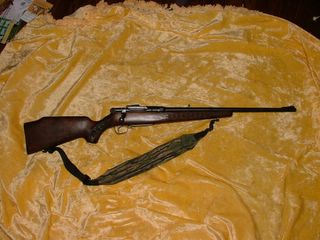
This is a bolt action repeater made, in this case, in .30-30 Winchester. There were very few bolt rifles made in this cartridge, and I'd rarely seen one of these. Barrel is 22 inches, it has a bead front and folding rear with a notch. It's light and handy, it'd work nicely in the woods. Trigger was light, I'd guess about 3-4 lbs, with a little creep.
One of the strange things about this is the magazine. Instead of a staggered-cartridge design it's a straight, like the Mosin Nagant. This one hold three cartridges; any more and the mag would stick out from the receiver bottom. And it's damn near impossible to load it from the top, you have to drop the mag to load. You can load single rounds, but you can't just drop it in and close the bolt, you have to push it into the chamber and then close, and with a flat-nose bullet it can be a bit of a pain.
Good things are, as mentioned, it's light and handy, and since you don't have to worry about a cartridge nose hitting the primer ahead of it in the magazine, you can load it with pointed bullets. What I had today was some cast-bullet loads I made up for practice with a Winchester 94, it's a 150-grain RCBS flatnose bullet with a gas check. If you're not familiar with this, on a gas-check bullet the base is slightly smaller diameter than the rest of the bullet body, and a copper cup is locked on. With lead bullets there are definate limits to how fast you can push them without badly fouling the bore; with a gas check on the base, you can drive them faster without a big mess to clean up. This load, if I remember correctly, drives the bullet about 1500fps, and is fairly accurate in my 94(I've also used this bullet in practice ammo for a .308, it's very versitile). So I tried it out, and got a pleasant surprise; very good accuracy out of this rifle. I'd started off at 50 yards, and then went to 100. My last five shots are below:
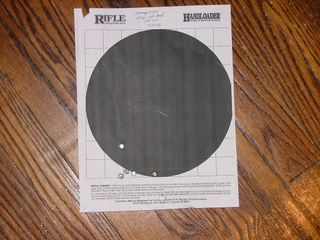
Overall group size is 2 3/8", with three within 3/4". That's accuracy that would put meat on the table at that range, and it's possible that with better sights- or a scope- that overall would tighten up nicely. Overall, it's a good rifle I wouldn't mind having. I've always liked the .30-30, and think a double-barrel in this cartridge would make a fine deer rifle in many areas. Maybe someday, if I win the lottery...
The other to try out is an odd beast, the Nagant Revolver
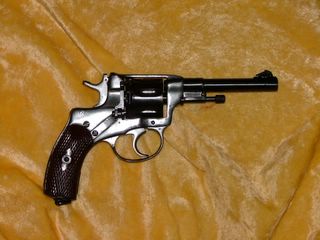
This thing fires a 7.62mm bullet(actual diameter about .311 I think) out of one of the stranger cartridges I've seen:
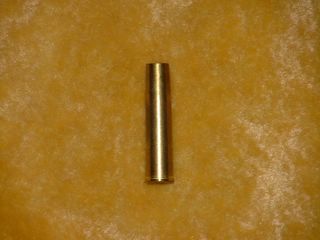
It's 1.5" long, and the bullet is seated way down inside the case(this is some Russian target ammo from SOG). When you cock the hammer, not only does the cylinder rotate, at the end it cams forward so the end of the case actually sits inside the forcing cone. When you fire, the case seals so you have no flash, and no pressure loss, between cylinder and bore. This makes this thing the only revolver I know of that will actually work very well with a silencer.
This one is a double-action, from what I've read they were also made single-action and double-action only. And it has what a friend once described as the 'trigger pull from Hell'. Single-action is not too bad, heavy but it breaks cleanly. Double-action is awful; heavy and it stacks toward the end. Sights are a tapered front post and a notch rear, though there are some target models with adjustable sights on the market.
I shot this one at ten yards, and was pleasantly surprised with the accuracy. Single-action fire gave nice tight groups(this ammo is a hollow-base wadcutter) as long as you could work the heavy trigger. The thing has a heavy V mainspring, and if you had one to work on you might be able to lighten the spring a bit to improve the trigger, but I don't know that for certain, it's just a guess.
Ammo for this is either the Russian stuff shot today($15 for 40 rounds), Fiocci($25 to $30 for 50!) or handload. Starfire now makes brass for this cartridge, and RCBS has dies. Lee makes a die set to load ammo using .32-20 brass; from what I've read it works pretty well. This case isn't long enough to give the gas seal, but it's a lot less expensive than factory ammo and from what I've read, with the right bullet gives good results.
I'd like to have one of these because of the history of them, and the unique action. It's a Belgian design, selected by the Czar's army in Russia, and stayed in use clear through WWII.
Overall a much nicer day than I'd expected it to be when I woke up.
First, the Savage 340 Series E
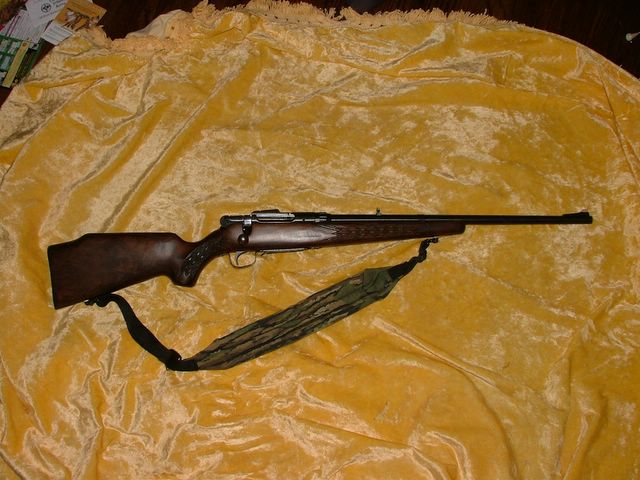
This is a bolt action repeater made, in this case, in .30-30 Winchester. There were very few bolt rifles made in this cartridge, and I'd rarely seen one of these. Barrel is 22 inches, it has a bead front and folding rear with a notch. It's light and handy, it'd work nicely in the woods. Trigger was light, I'd guess about 3-4 lbs, with a little creep.
One of the strange things about this is the magazine. Instead of a staggered-cartridge design it's a straight, like the Mosin Nagant. This one hold three cartridges; any more and the mag would stick out from the receiver bottom. And it's damn near impossible to load it from the top, you have to drop the mag to load. You can load single rounds, but you can't just drop it in and close the bolt, you have to push it into the chamber and then close, and with a flat-nose bullet it can be a bit of a pain.
Good things are, as mentioned, it's light and handy, and since you don't have to worry about a cartridge nose hitting the primer ahead of it in the magazine, you can load it with pointed bullets. What I had today was some cast-bullet loads I made up for practice with a Winchester 94, it's a 150-grain RCBS flatnose bullet with a gas check. If you're not familiar with this, on a gas-check bullet the base is slightly smaller diameter than the rest of the bullet body, and a copper cup is locked on. With lead bullets there are definate limits to how fast you can push them without badly fouling the bore; with a gas check on the base, you can drive them faster without a big mess to clean up. This load, if I remember correctly, drives the bullet about 1500fps, and is fairly accurate in my 94(I've also used this bullet in practice ammo for a .308, it's very versitile). So I tried it out, and got a pleasant surprise; very good accuracy out of this rifle. I'd started off at 50 yards, and then went to 100. My last five shots are below:
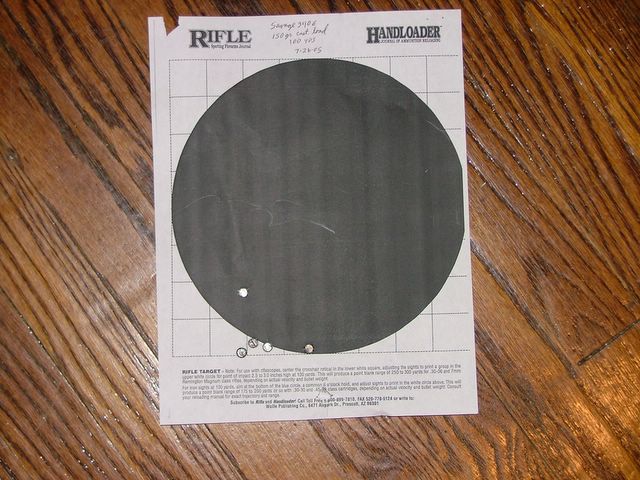
Overall group size is 2 3/8", with three within 3/4". That's accuracy that would put meat on the table at that range, and it's possible that with better sights- or a scope- that overall would tighten up nicely. Overall, it's a good rifle I wouldn't mind having. I've always liked the .30-30, and think a double-barrel in this cartridge would make a fine deer rifle in many areas. Maybe someday, if I win the lottery...
The other to try out is an odd beast, the Nagant Revolver

This thing fires a 7.62mm bullet(actual diameter about .311 I think) out of one of the stranger cartridges I've seen:

It's 1.5" long, and the bullet is seated way down inside the case(this is some Russian target ammo from SOG). When you cock the hammer, not only does the cylinder rotate, at the end it cams forward so the end of the case actually sits inside the forcing cone. When you fire, the case seals so you have no flash, and no pressure loss, between cylinder and bore. This makes this thing the only revolver I know of that will actually work very well with a silencer.
This one is a double-action, from what I've read they were also made single-action and double-action only. And it has what a friend once described as the 'trigger pull from Hell'. Single-action is not too bad, heavy but it breaks cleanly. Double-action is awful; heavy and it stacks toward the end. Sights are a tapered front post and a notch rear, though there are some target models with adjustable sights on the market.
I shot this one at ten yards, and was pleasantly surprised with the accuracy. Single-action fire gave nice tight groups(this ammo is a hollow-base wadcutter) as long as you could work the heavy trigger. The thing has a heavy V mainspring, and if you had one to work on you might be able to lighten the spring a bit to improve the trigger, but I don't know that for certain, it's just a guess.
Ammo for this is either the Russian stuff shot today($15 for 40 rounds), Fiocci($25 to $30 for 50!) or handload. Starfire now makes brass for this cartridge, and RCBS has dies. Lee makes a die set to load ammo using .32-20 brass; from what I've read it works pretty well. This case isn't long enough to give the gas seal, but it's a lot less expensive than factory ammo and from what I've read, with the right bullet gives good results.
I'd like to have one of these because of the history of them, and the unique action. It's a Belgian design, selected by the Czar's army in Russia, and stayed in use clear through WWII.
Overall a much nicer day than I'd expected it to be when I woke up.
Sunday, July 24, 2005
Forging, part 1
I thought I'd go through the process, and my favorite thing to make being blades, I'll focus on that this time.
This may sound silly, but before you start, decide just what it is you're going to make. Not just 'a knife', but details: how long a blade, how wide, what shape, what kind of tang and how long? That affects not only the making, but also the choice of steel. What I'd choose for a big, heavy-cutting type of blade isn't what I'd choose for a smaller general-purpose type. It also affects how big a fire you need; you only work a section at a time, until near the end, but a big knife will, obviously, start out with bigger stock and need more heat.
That decided, the steel in hand, light off the forge, let it burn a few minutes to clean out the fire, then put the first section in to heat. While it's heating make sure the tongs are handy(if needed), the hammers you'll need are handy, and any other tools- such as a fuller to narrow the blade at the tang- haven't wandered off to hide..
If you're starting with round bar stock, the first thing you do is flatten it, wide and thick enough to shape the blade. Again, a section at a time; unless you have a really big forge, about 6" is as much as you can heat at this stage. DO NOT hammer the stock too thin; leave it thicker than you need, as you can always thin it a bit more later. And, unless you want to leave hammer marks in the finished piece, you'll want to leave it a bit thick at the end, so you have enough mass to grind away the forge marks.
Ok, you've worked your way down, and have about 12" of the bar flattened out. I'll generally leave it attached to the main bar 'till near the end; holding onto the bar is generally more secure than using tongs. Now you shape the point.
Let's say you're making a bowie-style blade with a straight clip point like this one. You start off by heating the squared-off end and forging it down so that it tapers from the back of the blade to the edge, not the other way around(reason to come). You'll have to hammer the sides to keep the thickness even as you go, and you should wind up with a bar with a straight angle from a few inches back from the end down to the point. It may take several heats, depending on thickness/width/type of steel, just try to get it done with the least number possible. Every time you bring a piece up to red heat, you lose some metal from the hot surface combining with oxygen in the air and forming scale that falls off as you hammer.
Now, if you haven't already, decide how long you intend the blade to be from point to end of cutting edge, and either keep a steel ruler handy or mark it with soapstone or something. And now you can start forging in the bevels, the angles from the back of the blade to the edge.
Start at the point, and this is why you wanted to taper the end from the back down toward the edge. Bring a section up to heat, place it on the anvil face with the edge along one edge of the face, and start hammering. I use a 4lb. hammer with a nicely rounded face for this(not applicable all users, your results may vary), and start from the point and work my way back. This gets tricky because you don't want the hammer to be coming down squarely on the stock, you want it to come down at a bit of an angle, so the strike is thinning the edge and leaving further back thick. This does two things; first, it gives the blade a nice taper from back to edge and second, it stretches the edge further than the rest. This causes the point to curve back up, and with experience you can, by working the edge and the clip section of the back, adjust the shape so the point will be exactly where you want it. It can be amazing how much the point will move as you shape the bevels, in some blades I will shape the point as described above, then hammer it over the horn so it droops down below the edge; that way, when I shape the bevels of some shapes I don't wind up having to hammer the point back down because it's become too high.
Work this side, then put it back into the fire, get it up to heat, and then work the other side of the blade in the same area, preferably with roughly the same number of strokes(it helps keep things even). Then turn it edge up and look at it closely. The edge should be centered along the length you've worked so far; if it's not, even it up now. This works much better than doing the whole length and then trying to straighten it all- especially on long blades. Trust me.
When this is all as you want it- smooth taper from back to edge, point where you want it, move back to the next section, heat it and hammer. Two things to remember here: first, in a long blade you may have to give much of the blade a downward curve before you start hammering the bevels in, with a long blade it can be amazing how much the blade will curve up as you shape the bevels; second, remember to leave it thicker than you want the finished piece to be. Not only do you want to be able(generally speaking) to have enough stock to grind & polish out the forge marks, but by leaving it a bit thick, the finish grinding after heat treating will remove the surface steel that lost carbon to the fire. So work your way back to the point where the edge will end, and at that point you'll need to shape the ricasso- the area where the blade body meets the tang- and the tang. That'll be part two.
This may sound silly, but before you start, decide just what it is you're going to make. Not just 'a knife', but details: how long a blade, how wide, what shape, what kind of tang and how long? That affects not only the making, but also the choice of steel. What I'd choose for a big, heavy-cutting type of blade isn't what I'd choose for a smaller general-purpose type. It also affects how big a fire you need; you only work a section at a time, until near the end, but a big knife will, obviously, start out with bigger stock and need more heat.
That decided, the steel in hand, light off the forge, let it burn a few minutes to clean out the fire, then put the first section in to heat. While it's heating make sure the tongs are handy(if needed), the hammers you'll need are handy, and any other tools- such as a fuller to narrow the blade at the tang- haven't wandered off to hide..
If you're starting with round bar stock, the first thing you do is flatten it, wide and thick enough to shape the blade. Again, a section at a time; unless you have a really big forge, about 6" is as much as you can heat at this stage. DO NOT hammer the stock too thin; leave it thicker than you need, as you can always thin it a bit more later. And, unless you want to leave hammer marks in the finished piece, you'll want to leave it a bit thick at the end, so you have enough mass to grind away the forge marks.
Ok, you've worked your way down, and have about 12" of the bar flattened out. I'll generally leave it attached to the main bar 'till near the end; holding onto the bar is generally more secure than using tongs. Now you shape the point.
Let's say you're making a bowie-style blade with a straight clip point like this one. You start off by heating the squared-off end and forging it down so that it tapers from the back of the blade to the edge, not the other way around(reason to come). You'll have to hammer the sides to keep the thickness even as you go, and you should wind up with a bar with a straight angle from a few inches back from the end down to the point. It may take several heats, depending on thickness/width/type of steel, just try to get it done with the least number possible. Every time you bring a piece up to red heat, you lose some metal from the hot surface combining with oxygen in the air and forming scale that falls off as you hammer.
Now, if you haven't already, decide how long you intend the blade to be from point to end of cutting edge, and either keep a steel ruler handy or mark it with soapstone or something. And now you can start forging in the bevels, the angles from the back of the blade to the edge.
Start at the point, and this is why you wanted to taper the end from the back down toward the edge. Bring a section up to heat, place it on the anvil face with the edge along one edge of the face, and start hammering. I use a 4lb. hammer with a nicely rounded face for this(not applicable all users, your results may vary), and start from the point and work my way back. This gets tricky because you don't want the hammer to be coming down squarely on the stock, you want it to come down at a bit of an angle, so the strike is thinning the edge and leaving further back thick. This does two things; first, it gives the blade a nice taper from back to edge and second, it stretches the edge further than the rest. This causes the point to curve back up, and with experience you can, by working the edge and the clip section of the back, adjust the shape so the point will be exactly where you want it. It can be amazing how much the point will move as you shape the bevels, in some blades I will shape the point as described above, then hammer it over the horn so it droops down below the edge; that way, when I shape the bevels of some shapes I don't wind up having to hammer the point back down because it's become too high.
Work this side, then put it back into the fire, get it up to heat, and then work the other side of the blade in the same area, preferably with roughly the same number of strokes(it helps keep things even). Then turn it edge up and look at it closely. The edge should be centered along the length you've worked so far; if it's not, even it up now. This works much better than doing the whole length and then trying to straighten it all- especially on long blades. Trust me.
When this is all as you want it- smooth taper from back to edge, point where you want it, move back to the next section, heat it and hammer. Two things to remember here: first, in a long blade you may have to give much of the blade a downward curve before you start hammering the bevels in, with a long blade it can be amazing how much the blade will curve up as you shape the bevels; second, remember to leave it thicker than you want the finished piece to be. Not only do you want to be able(generally speaking) to have enough stock to grind & polish out the forge marks, but by leaving it a bit thick, the finish grinding after heat treating will remove the surface steel that lost carbon to the fire. So work your way back to the point where the edge will end, and at that point you'll need to shape the ricasso- the area where the blade body meets the tang- and the tang. That'll be part two.
Saturday, July 23, 2005
A way to try out new stuff, and one new rifle in particular
H&H range in Oklahoma City is having Dealer Days(or whatever they call it); lots of dealers displaying their wares. This setup has a nice addition; buy a ticket for $3- money going to the state shooting team- and if you find something you'd like to try out, give the dealer rep the ticket and you get the firearm and one load of ammo and a target. See the new Springfield or Taurus or whatever you'd like to try? Three bucks and you can!
They've done this before, this year there were enough vendors wanting in they're doing some this week and some next. What I specifically wanted to mention was something at the Kahr table; the M1 Carbine. Apparently they've got the rights to the design now, and are building it. First glance it looks like a standard M1 with a nicer stock and bluing, bayonet lug and all. Looked it over, very nice piece of wood, good fitting, nice balance, and in the original .30 carbine cartridge. And, instead of the turn-lever safety of the original, this one had a cross-bolt safety.
So I handed over my ticket and got the rifle and a magazine with ten rounds. I started at about 20 yards to check sighting, and it was dead on. I also found the other big difference from the original; instead of a two-stage trigger, it's got a single-stage that broke cleanly at about (I'm guessing) 3.5 pounds. After a couple of shots I ran the target out to 30 and finished the mag. Ten rounds with a rifle I'd never fired before all in a 2.5" bull, all offhand.
No, I didn't buy it. But dammit, I was tempted! I'm going to have to check around on this later when(hopefully) I've got some cash.
They've done this before, this year there were enough vendors wanting in they're doing some this week and some next. What I specifically wanted to mention was something at the Kahr table; the M1 Carbine. Apparently they've got the rights to the design now, and are building it. First glance it looks like a standard M1 with a nicer stock and bluing, bayonet lug and all. Looked it over, very nice piece of wood, good fitting, nice balance, and in the original .30 carbine cartridge. And, instead of the turn-lever safety of the original, this one had a cross-bolt safety.
So I handed over my ticket and got the rifle and a magazine with ten rounds. I started at about 20 yards to check sighting, and it was dead on. I also found the other big difference from the original; instead of a two-stage trigger, it's got a single-stage that broke cleanly at about (I'm guessing) 3.5 pounds. After a couple of shots I ran the target out to 30 and finished the mag. Ten rounds with a rifle I'd never fired before all in a 2.5" bull, all offhand.
No, I didn't buy it. But dammit, I was tempted! I'm going to have to check around on this later when(hopefully) I've got some cash.
The Brits are giving me hope
First there's this, money quote being:
"Under secret guidelines codenamed Operation Kratos, armed officers were instructed that they should shoot to kill suspected suicide bombers. “The most effective way of dealing with someone with explosives is to shoot them in the head,” said the officer.
S019 commanders also sent armed teams onto the streets of London in four Jankel armoured vehicles, bought by Scotland Yard last year for this eventuality. The vehicles are designed to protect their passengers from the impact of a suicide bomb blast.
Inside each vehicle were marksmen and women from the elite 72-man cadre of Specialist Firearms Officers (SFOs). The SFOs are divided into six teams of 12 which have been given different colour-coded names.
They are armed with Glock pistols, Heckler & Koch MP5 semi-automatic machineguns and G3 short-barreled rifles, which are small enough to be carried discreetly in a shoulder holsters. The rifles, equipped with “red dot” sights, use “frangible” ammunition that releases all its energy in the target’s body, instead of passing through it and endangering nearby civilians. "
Interesting that a government that will throw you in jail if you hurt someone who attacks you in your home will have plans waiting for 'you think he's a bomber, kill him'. Hypocritical as hell, but at least they did have a plan for it.
Second thing is this:
"Upstairs in the station, a passenger, Paul Martin, saw "a guy being chased. It was completely crazy. People were trying to drop him, to rugby tackle him," he told The Guardian."
So they're actually acting, this is good. Now if they'll start deporting the jihadis("I don't care what they'll do to him in Jordan, ship him out!"), and stop harassing people for acting in self-defense, they'll be well on their way.
"Under secret guidelines codenamed Operation Kratos, armed officers were instructed that they should shoot to kill suspected suicide bombers. “The most effective way of dealing with someone with explosives is to shoot them in the head,” said the officer.
S019 commanders also sent armed teams onto the streets of London in four Jankel armoured vehicles, bought by Scotland Yard last year for this eventuality. The vehicles are designed to protect their passengers from the impact of a suicide bomb blast.
Inside each vehicle were marksmen and women from the elite 72-man cadre of Specialist Firearms Officers (SFOs). The SFOs are divided into six teams of 12 which have been given different colour-coded names.
They are armed with Glock pistols, Heckler & Koch MP5 semi-automatic machineguns and G3 short-barreled rifles, which are small enough to be carried discreetly in a shoulder holsters. The rifles, equipped with “red dot” sights, use “frangible” ammunition that releases all its energy in the target’s body, instead of passing through it and endangering nearby civilians. "
Interesting that a government that will throw you in jail if you hurt someone who attacks you in your home will have plans waiting for 'you think he's a bomber, kill him'. Hypocritical as hell, but at least they did have a plan for it.
Second thing is this:
"Upstairs in the station, a passenger, Paul Martin, saw "a guy being chased. It was completely crazy. People were trying to drop him, to rugby tackle him," he told The Guardian."
So they're actually acting, this is good. Now if they'll start deporting the jihadis("I don't care what they'll do to him in Jordan, ship him out!"), and stop harassing people for acting in self-defense, they'll be well on their way.
Friday, July 22, 2005
Carnival of Cordite #23 up!
At a place called But That's Just My Opinion. Ammo, explosives and idiot ideas about, range tests and other good stuff.
Ever notice how many places you wind up seeing because of this?
Ever notice how many places you wind up seeing because of this?
Subscribe to:
Posts (Atom)