Besides the "We're all gonna die!!!" crap with mega-volcanos and mega-tsunamis and so forth, it's little things.
A while back they were talking about subduction zone earthquakes and talking about the northwest coast of North America they said something like "in the 200 years Europeans have lived here". 'Europeans'? Oh, please, can you come up with a better example of politically correct wording? Not 'written history', not 'documented history', not even 'the 200 years whites have lived here'. No, it's 'Europeans'.
Maybe the idiots who made this don't realize it, but having ancestors from Europe does not make you a European. If it did, then there wouldn't be American Indians, there'd be 'Asians who lived here'. (no, I don't call the tribes 'Native Americans'; that covers everyone born here)
Why do these clowns have to crap things up like this?
Saturday, August 27, 2005


Friday, August 26, 2005
Carnival of Cordite#28
is up over at Gullyborg. All kinds of tests and information, including the latest on that godawful mess in VA at the gun show.
This thing has gone on for 28 issues now, and still going strong. Don't you love it?
On that mess in VA, I first heard about it from Kim here; he had a followup here, which includes how the ATFE people probably got the personal information to make these 'residence checks'. Ravenwood has more here. There is NO excuse for this kind of nonsense, and I hope Showmasters goes the full legal mile.
This thing has gone on for 28 issues now, and still going strong. Don't you love it?
On that mess in VA, I first heard about it from Kim here; he had a followup here, which includes how the ATFE people probably got the personal information to make these 'residence checks'. Ravenwood has more here. There is NO excuse for this kind of nonsense, and I hope Showmasters goes the full legal mile.
Thursday, August 25, 2005
And for anyone who speaks of the 'wonders of law enforcement in Britain',
give them this. Father and son grabbed, held, DNA samples taken, the whole bloody works. For plastic toy guns.
This is why we have to scream and yell and throw fits when something like the previous post happens; for our descendants and ourselves, we CANNOT let this happen here.
This is why we have to scream and yell and throw fits when something like the previous post happens; for our descendants and ourselves, we CANNOT let this happen here.
Major media slant and federal agency abuse
First, this story from Jack Kelly, on how an Army officer gave the New York Times some good news, and the Times(surprise!) spun it to look as bad as possible. Jackasses.
And Kim had something on this a couple of days ago, found this this morning on that mess at a VA gun show. Read it. There is no excuse for these actions, period. And like other abuses, it makes it that much harder for the officers/agents actually trying to do the job right to do so.
And Kim had something on this a couple of days ago, found this this morning on that mess at a VA gun show. Read it. There is no excuse for these actions, period. And like other abuses, it makes it that much harder for the officers/agents actually trying to do the job right to do so.
Wednesday, August 24, 2005
In the spirit of 'Step by Step', how to make a fork
Not just any fork, mind you, but the heavy-duty, solid steel Roasting Fork! Good for marshmallows, hot dogs, brats, large squirrels, small rabbits and (shudder) any odd chunks of vegetable you might wish to carbonize. And since I remembered to take the camera with me in time, here it is.
I use 3/16" square stock for most of these, you can use heavier if you need to make a sturdier one. I can usually work on three of these at a time, it's faster and easier than one at a time. I have done four when in a hurry. Cut a section 30" long, and put one end in the fire.

When at a nice red heat, flatten the last inch a bit
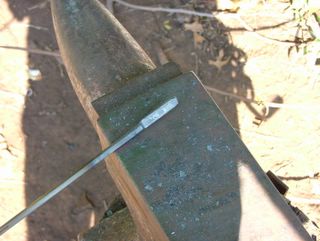
Back into the fire, heat, then use the hot cutter I pictured a while back to split the flattened section, then spread the two tines.

I can't remember if I said it before, but if you're cutting on the anvil face, use a piece of mild steel on the face; it protects the face from getting dinged and your chisel edge from being destroyed.
Heat one tine, then to the anvil to draw it out longer & thinner. Hit on one side, turn it 1/4 turn and hit, repeat back & forth till you have the length you desire.
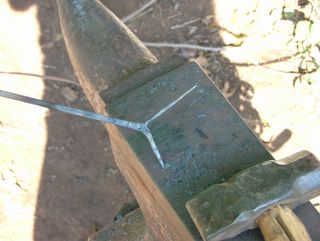
Heat & draw out the other tine.

Now heat both, and use tongs, pliers, whatever to bend them to your chosen fork shape.
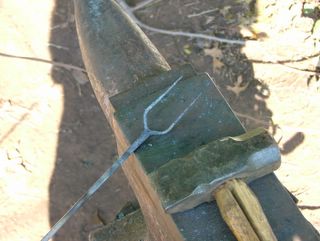
Now, just for decoration, I like to put a twist in the stock just behind the fork. I use this tool:

which has a slot cut & filed to just fit over the stock. Remember, when the stuff it hot it expands, so this'll be a bit loose on a cold piece. Heat the stock for a few inches behind the fork, clamp the shank in the vise, put your twisting tool on the stock, and twist. However much you like, clockwise or widdershins doesn't matter. When making these at a fair I'll sometimes use less/more or left/right in a set so someone's kids won't argue about which belongs to who.

Now it should look something like this:

Now for something to hold on to, flatten the other end

Curl it back. Get it hot, bend the very end over the anvil, then hold it on the face and tap with a hammer on the end; you can curl it right up.

Now heat a few inches back, set on the anvil, grab with tongs and bend back
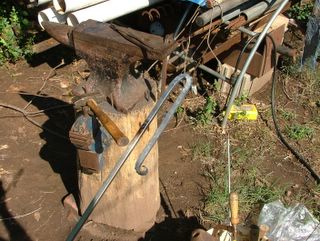
To close it I heat the end, set the long side on the anvil and use a hold-down to brace it just before the closed-end curve, then use tongs to bend the open end closed.
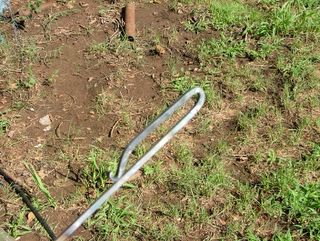
And it comes out something like this
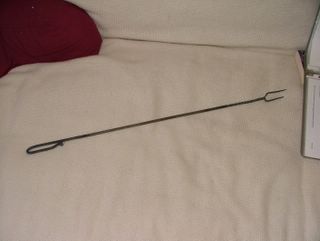
I'll wire-brush these to clean them off, then paint with linseed oil; let it sit a few minutes, wipe off the excess, then hang up in the garage to dry. It does a pretty good job of preventing rust, and gives the piece a nice look.
There, isn't that simple? Disregard that it was mid-80's and humidity in the mid-90's this morning(oh, how I suffer for my art!) and I thought I was going to drown in my own sweat, just express your appreciation appropriately. Cash, good whiskey or- never mind.
I use 3/16" square stock for most of these, you can use heavier if you need to make a sturdier one. I can usually work on three of these at a time, it's faster and easier than one at a time. I have done four when in a hurry. Cut a section 30" long, and put one end in the fire.
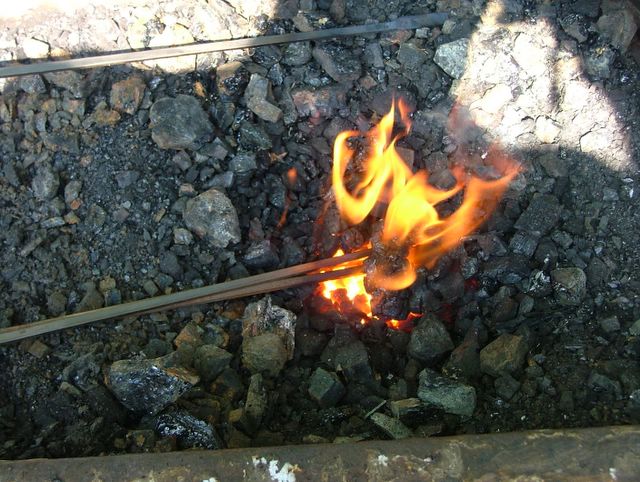
When at a nice red heat, flatten the last inch a bit
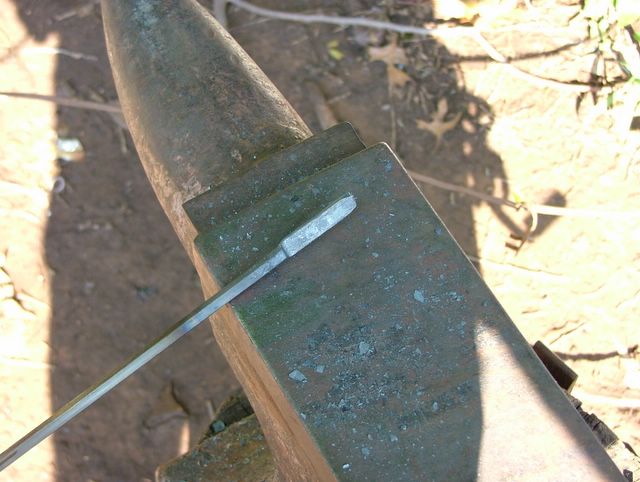
Back into the fire, heat, then use the hot cutter I pictured a while back to split the flattened section, then spread the two tines.
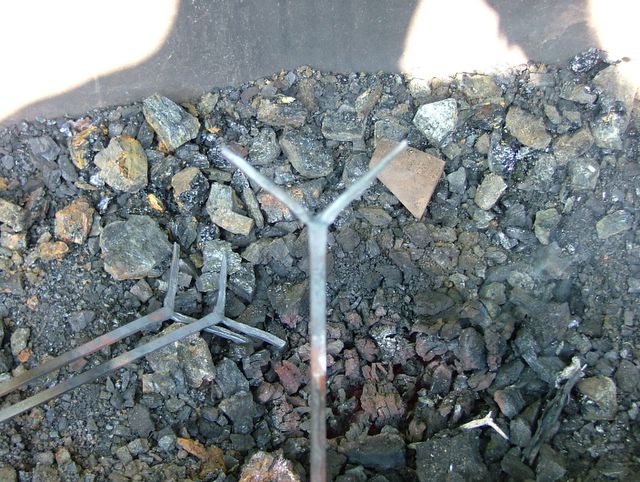
I can't remember if I said it before, but if you're cutting on the anvil face, use a piece of mild steel on the face; it protects the face from getting dinged and your chisel edge from being destroyed.
Heat one tine, then to the anvil to draw it out longer & thinner. Hit on one side, turn it 1/4 turn and hit, repeat back & forth till you have the length you desire.
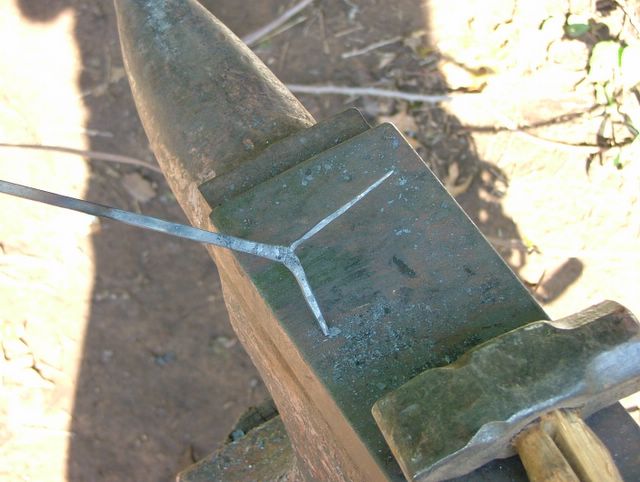
Heat & draw out the other tine.

Now heat both, and use tongs, pliers, whatever to bend them to your chosen fork shape.

Now, just for decoration, I like to put a twist in the stock just behind the fork. I use this tool:

which has a slot cut & filed to just fit over the stock. Remember, when the stuff it hot it expands, so this'll be a bit loose on a cold piece. Heat the stock for a few inches behind the fork, clamp the shank in the vise, put your twisting tool on the stock, and twist. However much you like, clockwise or widdershins doesn't matter. When making these at a fair I'll sometimes use less/more or left/right in a set so someone's kids won't argue about which belongs to who.

Now it should look something like this:
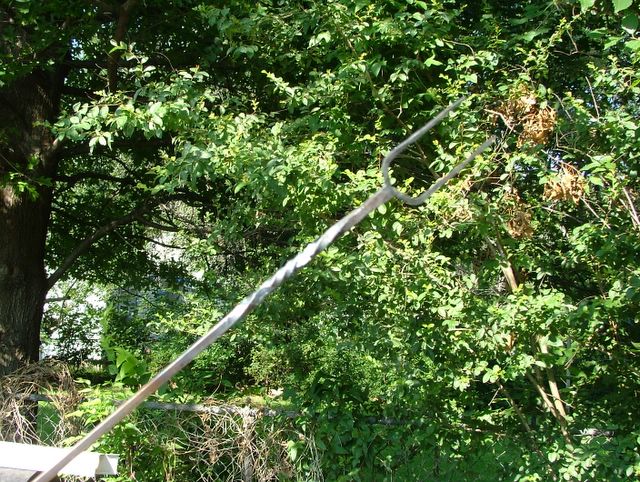
Now for something to hold on to, flatten the other end

Curl it back. Get it hot, bend the very end over the anvil, then hold it on the face and tap with a hammer on the end; you can curl it right up.
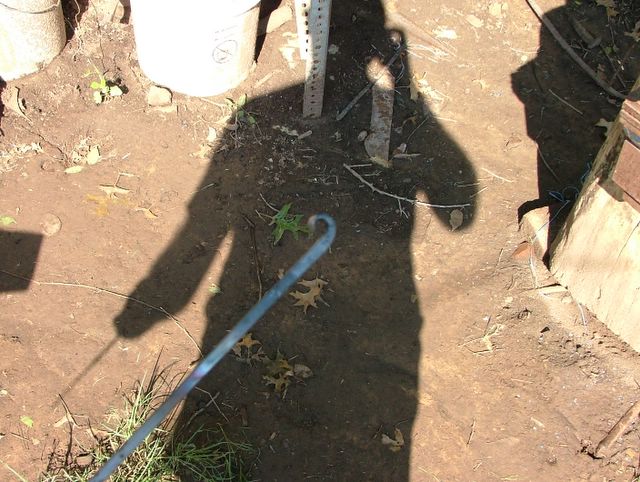
Now heat a few inches back, set on the anvil, grab with tongs and bend back

To close it I heat the end, set the long side on the anvil and use a hold-down to brace it just before the closed-end curve, then use tongs to bend the open end closed.

And it comes out something like this

I'll wire-brush these to clean them off, then paint with linseed oil; let it sit a few minutes, wipe off the excess, then hang up in the garage to dry. It does a pretty good job of preventing rust, and gives the piece a nice look.
There, isn't that simple? Disregard that it was mid-80's and humidity in the mid-90's this morning(oh, how I suffer for my art!) and I thought I was going to drown in my own sweat, just express your appreciation appropriately. Cash, good whiskey or- never mind.
Animal rights people are insane
They can't convince/threaten a family into stopping their business of breeding guinea pigs for medical research, so they dig up and steal the body of a relative and refuse to return it until the family goes out of business. And one of the idiots in charge of this loose association of terrorists says it's a 'victory'.
Hey, stupid! I'm having chicken tonight!
Hey, stupid! I'm having chicken tonight!
Tuesday, August 23, 2005
Here's one for Acidman
Rob is, shall we say, not enamored of snakes. One of my neighbors was a medic in an infantry unit in Vietnam, also detests snakes, and told me this story:
His unit went out one day with strict orders to make no noise; basically, "Unless the enemy sees you and you have to shoot, do nothing to let them know you're there". So they went out into the jungle, and as they passed through an area the lieutenant suddenly said "Sergeant, don't move!" The sergeant, thinking it was a mine or boobytrap, froze, then looked down.
He was standing astride a python, and it had reared up in front of him- the lieutenant saw it just as it moved- and was poised with its' mouth open about 18" from the sergeants' crotch. Now, a python is not venomous, but they have lots of sharp teeth and can, to quote Capstick, bite the tax reform act out of you. The sergeant stayed very still, and the lieutenant slowly moved up- the snake making no effort to leave- then eased his rifle muzzle past the sergeants leg and almost into the snake's mouth, then pulled the trigger. Short burst, dead snake. So far, so good.
The captain now came on the radio for a contact report, and the lieutenant informed him no, no VC, just a BIG snake he had to shoot. This did not go over well, and the captain, probably thinking someone had a negligent discharge, ordered the snake brought back so he could see it.
Jim says this is where he really learned the value of keeping your mouth shut. The first thing he said after hearing they had to take it back was "I'm not carrying the sonofabitch", which was immediately followed by the officer pointing at him and saying "Get over here". So his load was spread around and he had to drape the damn thing over his shoulders and start walking. Think about this: with the head mostly blown off it dragged the ground on one side, went over his shoulders, then dragged on the other side. And that's a small python of the type. And he carried it for four kilometers back to base.
And just to make it really fun, every time they came out of shade into direct sunlight, the heat caused the nerves and muscles to react and it would start twisting around him. He says that after the first time he never noticed how heavy it was, because when in the sun it was moving on him, and when they got into shade it would calm down and he was so relieved that nothing else mattered.
They finally reached camp, and when the captain came out and asked where the blanking snake was, Jim walked up. The lieutenant grabbed the tail and told him to turn around, they unwound it and laid it out. The captain looked at it, and said "Well... Tomorrow, you head back out-" and that was all he said.
And yes, Jim STILL hates snakes.
His unit went out one day with strict orders to make no noise; basically, "Unless the enemy sees you and you have to shoot, do nothing to let them know you're there". So they went out into the jungle, and as they passed through an area the lieutenant suddenly said "Sergeant, don't move!" The sergeant, thinking it was a mine or boobytrap, froze, then looked down.
He was standing astride a python, and it had reared up in front of him- the lieutenant saw it just as it moved- and was poised with its' mouth open about 18" from the sergeants' crotch. Now, a python is not venomous, but they have lots of sharp teeth and can, to quote Capstick, bite the tax reform act out of you. The sergeant stayed very still, and the lieutenant slowly moved up- the snake making no effort to leave- then eased his rifle muzzle past the sergeants leg and almost into the snake's mouth, then pulled the trigger. Short burst, dead snake. So far, so good.
The captain now came on the radio for a contact report, and the lieutenant informed him no, no VC, just a BIG snake he had to shoot. This did not go over well, and the captain, probably thinking someone had a negligent discharge, ordered the snake brought back so he could see it.
Jim says this is where he really learned the value of keeping your mouth shut. The first thing he said after hearing they had to take it back was "I'm not carrying the sonofabitch", which was immediately followed by the officer pointing at him and saying "Get over here". So his load was spread around and he had to drape the damn thing over his shoulders and start walking. Think about this: with the head mostly blown off it dragged the ground on one side, went over his shoulders, then dragged on the other side. And that's a small python of the type. And he carried it for four kilometers back to base.
And just to make it really fun, every time they came out of shade into direct sunlight, the heat caused the nerves and muscles to react and it would start twisting around him. He says that after the first time he never noticed how heavy it was, because when in the sun it was moving on him, and when they got into shade it would calm down and he was so relieved that nothing else mattered.
They finally reached camp, and when the captain came out and asked where the blanking snake was, Jim walked up. The lieutenant grabbed the tail and told him to turn around, they unwound it and laid it out. The captain looked at it, and said "Well... Tomorrow, you head back out-" and that was all he said.
And yes, Jim STILL hates snakes.
Able Danger, and other cover-ups
Captain's Quarters has been, as Michelle Malkin puts it, 'on fire' with AD coverage, and also information on Gorelick and the 'wall' she put into place between law enforcement and intelligence. One of the things that strikes me about the Able Danger mess is the same that strikes me on the stuff coming out on the Oklahoma City Bombing: the coverup.
In both cases you've got people in government who had information about a serious threat, provided by intelligence work(both LE and military); either ignored it or mishandled it for various reasons; horrible events happened and people died; and the main concern of those in charge seems to be "Don't let anybody know we knew this!". Screw finding out exactly what went wrong, to hell with punishing people who didn't do their damn jobs, and making sure it doesn't happen again? Oh, really, how provincial! WE have to protect our agency/reputation/boss! That's FAR more important!
And that seems to be exactly what's happening on a number of fronts. Remember the FBI agent who wanted to get a warrant to search the suspect's laptop, and his boss refused to even request the warrant for fear of being seen as 'insensitive' or 'bigoted' or whatever? His career concerns mattered more than what might happen, and what did happen to him? Was he fired, disciplined, SOMETHING? Hell, no. The FBI agent who refused to wear a wire when talking to a suspect because 'a Muslim doesn't record another Muslim'? Fired, disciplined? Hell no, that would be seen as bigoted and/or insensitive, so he was PROMOTED and transferred somewhere else. In the FBI you have a culture that mimics other large bureaucracies like the Justice Department and State: the reputation of the organization is more important than anything else, and if we have to stonewall and coverup and, in all too many cases, flat-out lie to protect it, so be it.
And you KNOW there are a lot of people in all those agencies who are dying inside because of it. The FBI, as one example, has a lot of very good, very capable people. They joined to fight crime and catch bad guys and protect this country. A lot of them have attitude problems, but that doesn't change the fact that they are very, very good at what they do. And they get to sit there watching higher-ups turn down information and lose cases and endanger the very things these people value simply to protect/enhance the reputations of themselves and the Bureau. It has to be killing them inside to watch this, and yet they very rarely speak of it in public. I think there are three main reasons: hope, training and fear. Hope, in that they keep hoping things will get better and the job will get done right. Training because by the time you get through the FBI Academy, you've been taught that the Director sits at God's right hand and gives advice, and you're somewhat below that and don't make trouble for your 'betters'. And fear because they know what kind of trouble the Bureau can cause for someone who irritates the brass hats. Put it all together, it's a massive block to get through, and very few do. And in many cases they do accomplish good things, so they keep working at what they can, and push the pain of what's coming out into a corner. So I think.
All this isn't helped by Congress being so unwilling in so many cases to actually do something about wrongdoers. Because someone supports a political view or is in a favored agency or is just one of the 'good' or 'protected' people, they don't get whacked on the way they should when the do wrong. Remember the Keating Five? And McCain is still in office. Hell, Barney Frank had a boyfriend running a brothel out of Frank's house, and he basically got his hand slapped. Lightly. You've got a lot of people in office who'll protect, for instance, people in the State Department against almost anything because they have the 'right' point of view, and what's a little corruption or idiocy or treason compared to that?
Hmm? Oh, yes, I DO have an answer. Start holding these people accountable. Demote, fire, prosecute and so forth when they do wrong, no matter who they know and no matter what it does to the reputation of whatever agency/party. Unfortunately, not too likely to happen. I hope, but I also despair about this.
In both cases you've got people in government who had information about a serious threat, provided by intelligence work(both LE and military); either ignored it or mishandled it for various reasons; horrible events happened and people died; and the main concern of those in charge seems to be "Don't let anybody know we knew this!". Screw finding out exactly what went wrong, to hell with punishing people who didn't do their damn jobs, and making sure it doesn't happen again? Oh, really, how provincial! WE have to protect our agency/reputation/boss! That's FAR more important!
And that seems to be exactly what's happening on a number of fronts. Remember the FBI agent who wanted to get a warrant to search the suspect's laptop, and his boss refused to even request the warrant for fear of being seen as 'insensitive' or 'bigoted' or whatever? His career concerns mattered more than what might happen, and what did happen to him? Was he fired, disciplined, SOMETHING? Hell, no. The FBI agent who refused to wear a wire when talking to a suspect because 'a Muslim doesn't record another Muslim'? Fired, disciplined? Hell no, that would be seen as bigoted and/or insensitive, so he was PROMOTED and transferred somewhere else. In the FBI you have a culture that mimics other large bureaucracies like the Justice Department and State: the reputation of the organization is more important than anything else, and if we have to stonewall and coverup and, in all too many cases, flat-out lie to protect it, so be it.
And you KNOW there are a lot of people in all those agencies who are dying inside because of it. The FBI, as one example, has a lot of very good, very capable people. They joined to fight crime and catch bad guys and protect this country. A lot of them have attitude problems, but that doesn't change the fact that they are very, very good at what they do. And they get to sit there watching higher-ups turn down information and lose cases and endanger the very things these people value simply to protect/enhance the reputations of themselves and the Bureau. It has to be killing them inside to watch this, and yet they very rarely speak of it in public. I think there are three main reasons: hope, training and fear. Hope, in that they keep hoping things will get better and the job will get done right. Training because by the time you get through the FBI Academy, you've been taught that the Director sits at God's right hand and gives advice, and you're somewhat below that and don't make trouble for your 'betters'. And fear because they know what kind of trouble the Bureau can cause for someone who irritates the brass hats. Put it all together, it's a massive block to get through, and very few do. And in many cases they do accomplish good things, so they keep working at what they can, and push the pain of what's coming out into a corner. So I think.
All this isn't helped by Congress being so unwilling in so many cases to actually do something about wrongdoers. Because someone supports a political view or is in a favored agency or is just one of the 'good' or 'protected' people, they don't get whacked on the way they should when the do wrong. Remember the Keating Five? And McCain is still in office. Hell, Barney Frank had a boyfriend running a brothel out of Frank's house, and he basically got his hand slapped. Lightly. You've got a lot of people in office who'll protect, for instance, people in the State Department against almost anything because they have the 'right' point of view, and what's a little corruption or idiocy or treason compared to that?
Hmm? Oh, yes, I DO have an answer. Start holding these people accountable. Demote, fire, prosecute and so forth when they do wrong, no matter who they know and no matter what it does to the reputation of whatever agency/party. Unfortunately, not too likely to happen. I hope, but I also despair about this.
Monday, August 22, 2005
Putting an edge on it
Over the years I've used all kinds of things to sharpen knives and axes. Stones, sticks, sanding belts and so forth. They've all got their good and bad points. A good stone will put a fine edge on, but can take forever, and you really need at least two stones: a medium for setting up a good edge bevel on a new blade or repairing a badly dulled or damaged edge, and a fine for finishing the edge off. Mind you, this method has worked for several thousand years and still does the job quite well. One of the best types of stone I've found is the Norton Crystolon for fast cutting, and an India or Arkansas stone for finishing the edge. Side note, a hard Arkansas does a pretty nice job of putting a polish on trigger or other action parts, too.
There are some very nice ceramic sharpeners out there. Some are sticks, round or otherwise, some are flat rectangles. I've got some small ceramic stones, about 2x3" I found at a surplus store that are great for touching up an edge, pretty fast-cutting and clean up with water. There are round ones with handles called 'crock sticks' you use like a butchers steel. I've also used a Spyderco sharpener. It's a plastic base that holds two triangular ceramic sticks, corners are medium grit and flats are fine; you put the sticks in the base and draw the edge of the knife along the sticks, one side and then the other. Not a bad tool, if you're careful you can vary the angle of the edge to get different bevels.
Then there are some systems that use a fixture that holds the blade, and small stones you attach to guide rods. There are holes in the fixture the rods go through to set the angle, and you draw the stone along the edge- Lansky is a common one. These work very well, and if you have trouble keeping the edge at the same angle as you work, this is a good system.
I mentioned sanding belts. I use a fine belt, about 240 grit, to do the initial sharpening on blades I make, then either a fine stone or steel to finish it. It's fast, but if you're not damn careful you can overheat the edge in a spot, or take off too much. And if I want a really, really fine edge I take a hard felt buffing wheel, which will keep a nice flat surface, load it with a fine polishing compound and finish the edge with that. Not that good for heavy-cutting edges, but if you need a really smooth, fine edge it's wonderful. It also has the added advantage of being a bit dangerous; you get careless with that buffed edge doing the final touch, and you'll be bleeding before you realize you've been cut.
Yes, knife people are a bit strange.
One of the tools I use most, because it a: works and b: I can carry it around, is this Gerber steel:

The narrow edges is medium, the flats are fine. It folds into the leather for carry, and the leather gives you a handle when you use it. I've used this thing on knives, axes, swords and scissors with good results. It doesn't show in the picture, but the leather's a bit beat up from the years and use, but it's still going strong. When you're finished, wipe it lengthwise with a cloth and a bit of oil and the metal bits come out of the grooves and it's ready for next time.
I haven't much experience with the various diamond stones. The idea is good, I'd guess how one works depends on how well the diamond dust is bonded to the substrate. I have known people who swear by them.
In history they've used- still use- everything from a smooth rock from a riverbed to a building block to sharpen tools; there are stones in Hadrian's Wall hollowed out in the center from countless soldiers touching up a blade on them. But it is a bit easier with something intended for the purpose.
There are some very nice ceramic sharpeners out there. Some are sticks, round or otherwise, some are flat rectangles. I've got some small ceramic stones, about 2x3" I found at a surplus store that are great for touching up an edge, pretty fast-cutting and clean up with water. There are round ones with handles called 'crock sticks' you use like a butchers steel. I've also used a Spyderco sharpener. It's a plastic base that holds two triangular ceramic sticks, corners are medium grit and flats are fine; you put the sticks in the base and draw the edge of the knife along the sticks, one side and then the other. Not a bad tool, if you're careful you can vary the angle of the edge to get different bevels.
Then there are some systems that use a fixture that holds the blade, and small stones you attach to guide rods. There are holes in the fixture the rods go through to set the angle, and you draw the stone along the edge- Lansky is a common one. These work very well, and if you have trouble keeping the edge at the same angle as you work, this is a good system.
I mentioned sanding belts. I use a fine belt, about 240 grit, to do the initial sharpening on blades I make, then either a fine stone or steel to finish it. It's fast, but if you're not damn careful you can overheat the edge in a spot, or take off too much. And if I want a really, really fine edge I take a hard felt buffing wheel, which will keep a nice flat surface, load it with a fine polishing compound and finish the edge with that. Not that good for heavy-cutting edges, but if you need a really smooth, fine edge it's wonderful. It also has the added advantage of being a bit dangerous; you get careless with that buffed edge doing the final touch, and you'll be bleeding before you realize you've been cut.
Yes, knife people are a bit strange.
One of the tools I use most, because it a: works and b: I can carry it around, is this Gerber steel:
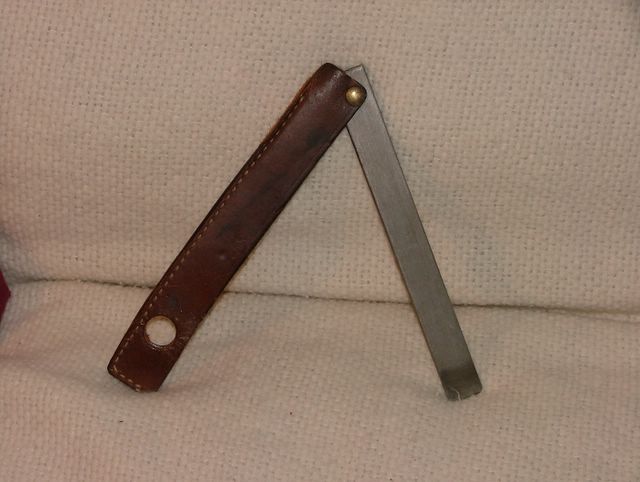
The narrow edges is medium, the flats are fine. It folds into the leather for carry, and the leather gives you a handle when you use it. I've used this thing on knives, axes, swords and scissors with good results. It doesn't show in the picture, but the leather's a bit beat up from the years and use, but it's still going strong. When you're finished, wipe it lengthwise with a cloth and a bit of oil and the metal bits come out of the grooves and it's ready for next time.
I haven't much experience with the various diamond stones. The idea is good, I'd guess how one works depends on how well the diamond dust is bonded to the substrate. I have known people who swear by them.
In history they've used- still use- everything from a smooth rock from a riverbed to a building block to sharpen tools; there are stones in Hadrian's Wall hollowed out in the center from countless soldiers touching up a blade on them. But it is a bit easier with something intended for the purpose.
More on the Trentadue & OKC Bombing cases
KTOK-AM had this today: "A newly released lawsuit deposition reveals now-retired Oklahoma Medical Examiner Doctor Fred Jordan changed his testimony about the August 1995 mysterious death of federal prison inmate Kenneth Trentadue and stated Trentadue had been involved in a fight before he died and might have been strangled with a plastic handcuff."
This goes on into, among other things, the retired ME saying in sworn testimony that Trentadue had died due to suicide, with his injuries being caused by the way he did it, and telling the Trentadue family, and writing in the file, ""I indicated that I felt Mr. Trentadue had been abused and tortured and at this point was not sure whether his death could be explained as a suicide or whether it should be regarded as a homicide."" And stating in a later deposition "Jordan went on to claim in the December 2002 deposition, given on the eve of his retirement as State Medical Examiner that he had been subjected to harassment and intimidation by FBI agents. "I don't think there's any question I was harassed by the Department of Justice from the very beginning of this, the 21st of August when we were denied access to do a job we'd been summoned to do,"".
Ok, this is getting worse and worse as time goes by. The documents the Trentadue family has received so far, after years of fighting, had already revealed some really nasty stuff. Now, on top of earlier reports of the normal investigative routine of a death at the facility being trashed, we have the ME at the time saying the Justice Department- not just the FBI- harassing him. Oh, and as to his 'suicide by hanging'? "...a picture of Kenneth Trentadue showing the deep bloody wounded across his death. He said the marks left on Trentadue's neck appeared to be those made by plastic handcuffs which had left tiny ladder like marks from one end of the wound to the other."
I repeat what I said earlier; the longer this is dragged out, the worse it's going to be.
You know, I haven't heard much of anything about this on any MSM site. I can't speak of the evening news, because I haven't watched it in a long time(I just don't trust them anymore). But I do have to wonder; with everything that's coming out about both the bombing and the Trentadue case, why not? You have FBI and federal lawyers from the Justice Department lying to a judge and defense attorney, you have evidence being covered up and/or destroyed, you have efforts to silence Mr. Trentadue, you have at least one man dead in circumstances you'd think would have reporters and journalists all over the place asking questions. I have to wonder if it's at least partly because who was President and who was Attorney General at the time this stuff happened: Bill Clinton and Janet Reno.
Whatever the reason, it's a shame. And this also connects back to all the work Jayna Davis did that found interesting connections between McVeigh and the bombing and, among others, possible Iraqi intelligence agents. You know, the stuff that the feds said was a load of crap, with no facts behind it?
Brings up the question as to just who is full of crap.
This goes on into, among other things, the retired ME saying in sworn testimony that Trentadue had died due to suicide, with his injuries being caused by the way he did it, and telling the Trentadue family, and writing in the file, ""I indicated that I felt Mr. Trentadue had been abused and tortured and at this point was not sure whether his death could be explained as a suicide or whether it should be regarded as a homicide."" And stating in a later deposition "Jordan went on to claim in the December 2002 deposition, given on the eve of his retirement as State Medical Examiner that he had been subjected to harassment and intimidation by FBI agents. "I don't think there's any question I was harassed by the Department of Justice from the very beginning of this, the 21st of August when we were denied access to do a job we'd been summoned to do,"".
Ok, this is getting worse and worse as time goes by. The documents the Trentadue family has received so far, after years of fighting, had already revealed some really nasty stuff. Now, on top of earlier reports of the normal investigative routine of a death at the facility being trashed, we have the ME at the time saying the Justice Department- not just the FBI- harassing him. Oh, and as to his 'suicide by hanging'? "...a picture of Kenneth Trentadue showing the deep bloody wounded across his death. He said the marks left on Trentadue's neck appeared to be those made by plastic handcuffs which had left tiny ladder like marks from one end of the wound to the other."
I repeat what I said earlier; the longer this is dragged out, the worse it's going to be.
You know, I haven't heard much of anything about this on any MSM site. I can't speak of the evening news, because I haven't watched it in a long time(I just don't trust them anymore). But I do have to wonder; with everything that's coming out about both the bombing and the Trentadue case, why not? You have FBI and federal lawyers from the Justice Department lying to a judge and defense attorney, you have evidence being covered up and/or destroyed, you have efforts to silence Mr. Trentadue, you have at least one man dead in circumstances you'd think would have reporters and journalists all over the place asking questions. I have to wonder if it's at least partly because who was President and who was Attorney General at the time this stuff happened: Bill Clinton and Janet Reno.
Whatever the reason, it's a shame. And this also connects back to all the work Jayna Davis did that found interesting connections between McVeigh and the bombing and, among others, possible Iraqi intelligence agents. You know, the stuff that the feds said was a load of crap, with no facts behind it?
Brings up the question as to just who is full of crap.
Saturday, August 20, 2005
Mexico, what to do about
Was browsing around and a link took me here(dammit, I can't remember where I found the link at!), a guy living in Mexico and his thoughts on what it'll take to fix the situation there.
Short version about a century. With luck.
I've never been there, so I'm going by many things I've heard and read. I know it's about the only country where the State Department recommended that any U.S. citazen getting in a legal problem is better off paying a bribe than trying to handle it in court(do they still recommend that?). I know that in many cities they paid police a bare-minimum salary because it was expected they would take bribes. But his description is amazing.
Take a look and see what you think about it.
My primary take for the last few years was wishing President Fox would shut the hell up about how Mexicans have a 'right' to come here any time they please, and worry about fixing his own damn country. This post just made it worse. It also made worse my wish that Pres. Bush would tell him to shut the hell up and start doing something on his side of the border.
Short version about a century. With luck.
I've never been there, so I'm going by many things I've heard and read. I know it's about the only country where the State Department recommended that any U.S. citazen getting in a legal problem is better off paying a bribe than trying to handle it in court(do they still recommend that?). I know that in many cities they paid police a bare-minimum salary because it was expected they would take bribes. But his description is amazing.
Take a look and see what you think about it.
My primary take for the last few years was wishing President Fox would shut the hell up about how Mexicans have a 'right' to come here any time they please, and worry about fixing his own damn country. This post just made it worse. It also made worse my wish that Pres. Bush would tell him to shut the hell up and start doing something on his side of the border.
Friday, August 19, 2005
More OKC Bombing news
KTOK-AM carried this story today: "Salt Lake City attorney Jesse Trentadue says he is surprised at the order of a federal judge who wants to see unredacted FBI files in Trentadue's Freedom of Information fight."
I mentioned in my last post on this that Mr. Trentadue had received a bunch of documents; they were heavily redacted, with names and information blacked out.
"Earlier this week the judge made it known to the FBI he wants to see the FBI files turned over to Trentadue last month. But Judge Dale A. Kimball told the FBI he personally wants to see the 'unredacted' version of the documents, those papers which have not been blacked out by the government to protect the names of individuals. The judge set a hearing for October 12th at 3pm."
This is serious stuff. If the judge sees that government lawyers lied to him, I believe that is an offense for which they can be disbarred and/or prosecuted. If the FBI agents involved are proven to have lied, I do believe that is called purjury, and carries a prison sentance. And it would almost certainly go 'way up the chain of command in the FBI and Justice Department.
If you haven't heard of this mess before, what started Trentadue digging into it? "Trentadue has been fighting the government for documents about the August 1995 death of his brother Kenneth Trentadue at the Oklahoma City Federal Transfer Center. He believes his brother died in a fierce FBI interrogation because he closedly matched the description of a suspect sought in the bombing of the Murrah building."
And the longer the government lawyers drag this out, the worse it'll be in the end.
I mentioned in my last post on this that Mr. Trentadue had received a bunch of documents; they were heavily redacted, with names and information blacked out.
"Earlier this week the judge made it known to the FBI he wants to see the FBI files turned over to Trentadue last month. But Judge Dale A. Kimball told the FBI he personally wants to see the 'unredacted' version of the documents, those papers which have not been blacked out by the government to protect the names of individuals. The judge set a hearing for October 12th at 3pm."
This is serious stuff. If the judge sees that government lawyers lied to him, I believe that is an offense for which they can be disbarred and/or prosecuted. If the FBI agents involved are proven to have lied, I do believe that is called purjury, and carries a prison sentance. And it would almost certainly go 'way up the chain of command in the FBI and Justice Department.
If you haven't heard of this mess before, what started Trentadue digging into it? "Trentadue has been fighting the government for documents about the August 1995 death of his brother Kenneth Trentadue at the Oklahoma City Federal Transfer Center. He believes his brother died in a fierce FBI interrogation because he closedly matched the description of a suspect sought in the bombing of the Murrah building."
And the longer the government lawyers drag this out, the worse it'll be in the end.
Part 4, hardening and tempering
Heat-treating is generally two steps. First, you have to get the piece up to critical temperature, evenly thoughout the length and width(more on that later), and quench it in whatever's appropriate for that steel to harden it. Second, you have to heat it up again, but to a much lower temperature; you have to ease the stresses in the blade enough that it won't be brittle, but will still be hard enough to hold an edge well.
What steel you used decides what the critical temperature will be, how you quench it, and how you temper it. Most of the fairly simple carbon steels are very similar in these respects; critical temperature is 1450-1550 degrees F. They can all be quenched in oil to harden. And the temperatures for tempering range from 350-600, depending on the steel and the use intended. A blade that has to be able to do heavy cutting and chopping shouldn't be as hard as one for fine work where you don't want to have to sharpen it often, for instance.
To touch basically- very basically- on how this works, steel has a crystilline structure that changes according to temperature and stress. When you heat it up to the critical temp, several things happen. The matrix of the structure opens up and carbon atoms can actually migrate through it(this is what allows case-hardening to work); the steel gets soft(duh); and most steels go non-magnetic(this temp is also known as the curie point). If you take a piece to a low heat, say 1200 F, and let it cool slowly, you normalize it, evening out and relieving stresses in the piece. If you get it to that temp and cool it very slowly, in hot ashes for instance, you can anneal it, making it as soft and easy to work as it can be, with the structure settling into, let's call it a relaxed structure(yes, there are specific words for the different states, but I can't remember them right now and don't have a reference handy; I'll try to add them in later). If you take it to the critical temperature and quench it, the structure freezes in a very stressed state, and under a microscope the structure will look different, with a needle-like appearance called martinsite(the one word I remember offhand). A high-carbon steel in this state is very hard; a sharp file won't cut it, and it's so brittle that dropping it might crack or break it. Tempering changes the structure a bit and relieves some of the stress, and here you have the hardness/toughness balancing act.
Let's say I'm making a large bowie or dirk out of 5160 spring stock. First problem is to get it up to proper heat along the full length. If you have access to or decide to buy or make an electric furnace, no problem; set the temperature to 1500F, set the blade in the oven and let it get to critical heat. In a forge, you may have to modify the firebed to get a long, narrow fire. What I wound up doing is taking a piece of about 3" diameter steel pipe long enough to fit into the firepot; split it lengthwise; then drill a bunch of holes in one half, no bigger than 1/4" and all along the length and partway down the sides. Then, get a piece of sheet steel and cut an hourglass shape out(you'll have to measure, cut and try to get it to fit), bend it in the middle, take the grate out of the firepot and set this into the hole. The idea is this piece will spread the air blast along the length of the pipe grate, instead of mostly hitting in the center. Set the pipe grate in place, and build your fire over it.
While the fire burns, make sure your quench method is ready. With smaller pieces you can use a can or bucket of oil, but for longer ones you'll need more length. A double-edge piece will have to be quenched point down, but a single-edge can be quenched lengthwise. I got a piece of steel channel about 3" square, cut one side open, and had ends welded on; I can fill it half to two-thirds full and do a fairly long and heavy blade in it. In either case the oil needs to be warmed, because it will flow better and give a more even effect; I usually set a piece of bar stock about 1" diameter in the fire while it's burning clean, and when the bar is low red, put it in the oil, you want it at about 100 F. A point here about single-edge blades; you don't have to heat them all the way from edge to back. Take a dirk that's about 2" wide at the ricasso and tapering. You can heat it so the area about 1/2" to 3/4" back from the edge is at critical temp and lower it edge-first into the oil. It'll smoke and bubble something fierce, and may ignite on the surface, so use tongs that will hold it securely and give you some distance. The advantages of this are two; first it's a lot easier in most cases to heat this section than the whole width of the blade, and this gives a hardened edge section with a softer, tougher back. Done right a blade like this is incredibly tough, and you probably won't live long enough to wear back through the hardened section. Further note: with a long single-edge blade, I try to finish the forging and grinding so the piece actually curves up toward the back a bit; when you quench it the edge section will shrink and pull it down into line.
You'll need to let the fire burn clean and even, then set the piece in. You want a very low air blast here; the piece needs to heat up slowly and evenly, so move it back & forth a bit too. You can check the temperature four ways. If you have one/access to one, an infrared thermometer would be nice. You can use a Templestick, a high-temperature crayon; pick one for the temp you want and either mark the blade and wait 'til it melts or lift it enough to wipe the crayon on it. You can use a magnet. When I mentioned they go non-magnetic, it means that at that temp a magnet will not stick, so you can use a shop magnet on a handle and touch it to the blade, when it doesn't stick you're there. And you can do it traditionally, learn to know the color that means you're there. I'd say a cherry red, but the description varies by who's giving it, so use some scrap pieces and practice. If the piece is not hot enough, it won't harden completely; too hot and the structure enlarges and the piece will be weaker than it should, in extreme cases the edge can actually crumble a bit under stress. So work the piece back & forth and watch the heat. When it's ready lift it out and put it into the quench. If you do this inside, you better have a fan set up for ventilation, especially with a big piece it takes a bit for it to lose heat and the oil will be smoking the whole time. Leave it until all heat coloring has disappeared, and if possible a while more, then take it out and let it cool completely. Turn the fire down but not out, because when the piece has reached ambient temperature, you need to clean it off thoroughly; inspect it for any warping so you'll know where to straighten it(mark with soapstone or something similar); and harden it again. I generally do two quenches with most steels. After the second, leave it in the oil for a while, then take it out and let it cool. And unless you're doing another piece, you can put the fire out now.
When the piece is all the way cooled off, inspect it again, and if all is well you can start tempering it. I wipe it down thoroughly, then wash it with dish soap(Dawn in my case) to get rid of the scale and oil, and put it in the oven. Yes, the one I bake in, which is why I'm fairly damn picky about washing all the oil off first. I set the heat at 375 F for the first heat, let it get up to temp and then leave it for about an hour. Then I pull it out and let it cool, then I hit it with the belt grinder to shine the sides up. I could probably do this before the first heat, but if I drop it it might crack, so I do one heat first. After shining it up I put it back in and, in the case of a piece like this, set the heat up to 425, leave it for long enough to get up to heat plus one hour. Pull it out, let it cool and check the color. For a big blade like this I want a bronze color, or dark yellow, along the edge. If it's lighter than that I increase the heat for the next time. If it got too hot? I reduce the heat by 25 degrees for the next heat, and hope the testing shows it's not softer than I want. Which is why I start below what I figure is needed and work up. And yes, for some things I know what temp I want and just go with it, but for bigger or more intricate shapes I start a bit low.
I do three tempering heats, cooling completely between. After cooling from the last heat, it's time for the next step: testing.
What steel you used decides what the critical temperature will be, how you quench it, and how you temper it. Most of the fairly simple carbon steels are very similar in these respects; critical temperature is 1450-1550 degrees F. They can all be quenched in oil to harden. And the temperatures for tempering range from 350-600, depending on the steel and the use intended. A blade that has to be able to do heavy cutting and chopping shouldn't be as hard as one for fine work where you don't want to have to sharpen it often, for instance.
To touch basically- very basically- on how this works, steel has a crystilline structure that changes according to temperature and stress. When you heat it up to the critical temp, several things happen. The matrix of the structure opens up and carbon atoms can actually migrate through it(this is what allows case-hardening to work); the steel gets soft(duh); and most steels go non-magnetic(this temp is also known as the curie point). If you take a piece to a low heat, say 1200 F, and let it cool slowly, you normalize it, evening out and relieving stresses in the piece. If you get it to that temp and cool it very slowly, in hot ashes for instance, you can anneal it, making it as soft and easy to work as it can be, with the structure settling into, let's call it a relaxed structure(yes, there are specific words for the different states, but I can't remember them right now and don't have a reference handy; I'll try to add them in later). If you take it to the critical temperature and quench it, the structure freezes in a very stressed state, and under a microscope the structure will look different, with a needle-like appearance called martinsite(the one word I remember offhand). A high-carbon steel in this state is very hard; a sharp file won't cut it, and it's so brittle that dropping it might crack or break it. Tempering changes the structure a bit and relieves some of the stress, and here you have the hardness/toughness balancing act.
Let's say I'm making a large bowie or dirk out of 5160 spring stock. First problem is to get it up to proper heat along the full length. If you have access to or decide to buy or make an electric furnace, no problem; set the temperature to 1500F, set the blade in the oven and let it get to critical heat. In a forge, you may have to modify the firebed to get a long, narrow fire. What I wound up doing is taking a piece of about 3" diameter steel pipe long enough to fit into the firepot; split it lengthwise; then drill a bunch of holes in one half, no bigger than 1/4" and all along the length and partway down the sides. Then, get a piece of sheet steel and cut an hourglass shape out(you'll have to measure, cut and try to get it to fit), bend it in the middle, take the grate out of the firepot and set this into the hole. The idea is this piece will spread the air blast along the length of the pipe grate, instead of mostly hitting in the center. Set the pipe grate in place, and build your fire over it.
While the fire burns, make sure your quench method is ready. With smaller pieces you can use a can or bucket of oil, but for longer ones you'll need more length. A double-edge piece will have to be quenched point down, but a single-edge can be quenched lengthwise. I got a piece of steel channel about 3" square, cut one side open, and had ends welded on; I can fill it half to two-thirds full and do a fairly long and heavy blade in it. In either case the oil needs to be warmed, because it will flow better and give a more even effect; I usually set a piece of bar stock about 1" diameter in the fire while it's burning clean, and when the bar is low red, put it in the oil, you want it at about 100 F. A point here about single-edge blades; you don't have to heat them all the way from edge to back. Take a dirk that's about 2" wide at the ricasso and tapering. You can heat it so the area about 1/2" to 3/4" back from the edge is at critical temp and lower it edge-first into the oil. It'll smoke and bubble something fierce, and may ignite on the surface, so use tongs that will hold it securely and give you some distance. The advantages of this are two; first it's a lot easier in most cases to heat this section than the whole width of the blade, and this gives a hardened edge section with a softer, tougher back. Done right a blade like this is incredibly tough, and you probably won't live long enough to wear back through the hardened section. Further note: with a long single-edge blade, I try to finish the forging and grinding so the piece actually curves up toward the back a bit; when you quench it the edge section will shrink and pull it down into line.
You'll need to let the fire burn clean and even, then set the piece in. You want a very low air blast here; the piece needs to heat up slowly and evenly, so move it back & forth a bit too. You can check the temperature four ways. If you have one/access to one, an infrared thermometer would be nice. You can use a Templestick, a high-temperature crayon; pick one for the temp you want and either mark the blade and wait 'til it melts or lift it enough to wipe the crayon on it. You can use a magnet. When I mentioned they go non-magnetic, it means that at that temp a magnet will not stick, so you can use a shop magnet on a handle and touch it to the blade, when it doesn't stick you're there. And you can do it traditionally, learn to know the color that means you're there. I'd say a cherry red, but the description varies by who's giving it, so use some scrap pieces and practice. If the piece is not hot enough, it won't harden completely; too hot and the structure enlarges and the piece will be weaker than it should, in extreme cases the edge can actually crumble a bit under stress. So work the piece back & forth and watch the heat. When it's ready lift it out and put it into the quench. If you do this inside, you better have a fan set up for ventilation, especially with a big piece it takes a bit for it to lose heat and the oil will be smoking the whole time. Leave it until all heat coloring has disappeared, and if possible a while more, then take it out and let it cool completely. Turn the fire down but not out, because when the piece has reached ambient temperature, you need to clean it off thoroughly; inspect it for any warping so you'll know where to straighten it(mark with soapstone or something similar); and harden it again. I generally do two quenches with most steels. After the second, leave it in the oil for a while, then take it out and let it cool. And unless you're doing another piece, you can put the fire out now.
When the piece is all the way cooled off, inspect it again, and if all is well you can start tempering it. I wipe it down thoroughly, then wash it with dish soap(Dawn in my case) to get rid of the scale and oil, and put it in the oven. Yes, the one I bake in, which is why I'm fairly damn picky about washing all the oil off first. I set the heat at 375 F for the first heat, let it get up to temp and then leave it for about an hour. Then I pull it out and let it cool, then I hit it with the belt grinder to shine the sides up. I could probably do this before the first heat, but if I drop it it might crack, so I do one heat first. After shining it up I put it back in and, in the case of a piece like this, set the heat up to 425, leave it for long enough to get up to heat plus one hour. Pull it out, let it cool and check the color. For a big blade like this I want a bronze color, or dark yellow, along the edge. If it's lighter than that I increase the heat for the next time. If it got too hot? I reduce the heat by 25 degrees for the next heat, and hope the testing shows it's not softer than I want. Which is why I start below what I figure is needed and work up. And yes, for some things I know what temp I want and just go with it, but for bigger or more intricate shapes I start a bit low.
I do three tempering heats, cooling completely between. After cooling from the last heat, it's time for the next step: testing.
Carnival of Cordite #27
Over at Gullyborg. Some interesting stuff again, so go see.
And when you can, look over his place; it's well worth the time.
And when you can, look over his place; it's well worth the time.
Wednesday, August 17, 2005
Ok, THIS just screws up my good mood
Went over to Kim's place and found this. Short version, they Brazilian the British cops killed was killed in error and the cops lied about it.
No 'heavy coat', no 'suspicious behaviour', no 'attempt to flee'. Instead the cops screwed the pooch bigtime and killed the man.
Crap. As Kim says, read the whole article here for the full flavor of this screwup.
No 'heavy coat', no 'suspicious behaviour', no 'attempt to flee'. Instead the cops screwed the pooch bigtime and killed the man.
Crap. As Kim says, read the whole article here for the full flavor of this screwup.
The Gunny Bestiary
The last time I went to the range, I found that some people had left behind what is termed, by handloaders, as a 'buttload' of .30-06 and .30-30 brass, heavy on the '06. It occurred to me, as I was picking this up, that there is a sub-species of shooter that might not be that familiar to the new shooter, and to some more experienced folks. Thus, I present this small contribution to your knowledge base.
The Handloader or Reloader (brassus used pickupus) is a somewhat common subtype of the shooting genus. Physical appearance can vary widely; both sexes can be found in this type. Often the male of this type has a mate who shakes her head and mutters things when he brings a new bounty into the nest area; females are usually mated to a male who is also a Reloader. There is some disagreement as to whether this is an actual subspecies, or simply a common shooter(bang-bang multiplus) who has been infected by some agent causing this change in behaviour.
In the nest area they are easy to tell. The work areas tend to have buckets/bags full of cartridge cases, instruments known as 'loading presses' and 'scales' and 'measures', and (often) numerous books and other publications on this subject. Occasionally the work area has a strange scent reminiscent of smokeless propellent, which when noticed causes cursing and a rapid search by the Handloader for any loose lids on containers. There may also be precision instruments(they claim) such as 'micrometers' and 'calipers'. The 'scale' and 'measure' should probably fit into this classification, but depending on whether they have been dropped/knocked down/shot, they may not actually be that precise.
In the 'open range' environment they sometimes may be told by plastic ammo boxes and notebooks on the bench; truly rabid specimens may have some of the 'scales' and/or 'measures' and a 'press' on the bench, where they mutter alchemical formulae and construct their own ammunition. These signs are often missing, however there is an almost no-fail method of telling the specimen; they will often be found, after they or someone else has finished shooting, walking around/in front of the benches in a crouch picking up fired cases. If in doubt, observe closely and you may well see the specimen holding the fired case in such a way as to attempt to see how many holes are in the bottom; since the hole/holes will be on the inside, this can lead to some amusing head and hand motions as they attempt to see inside.
In the clubhouse or gun store they may also be found speaking in tongues, referring to things such as 'meplat' and 'leade' and IMR(followed by numbers); they can sometimes become rather testy and loud when some other Handloader informs them that their 'pet load' doesn't work worth crap and that the Handloader being addressed is an idiot.
Overall the Handloader, while sometimes boring/annoying, is a harmless creature, as long as you do not smoke in the work area; this activity can cause serious upset in the being.
Although it is suspected to be an infectious activity as opposed to an actual different type, no special protection is required in their presence.
Although occasionally earplugs may be considered a plus. Especially if someone does smoke in the work area.
For what it's worth.
The Handloader or Reloader (brassus used pickupus) is a somewhat common subtype of the shooting genus. Physical appearance can vary widely; both sexes can be found in this type. Often the male of this type has a mate who shakes her head and mutters things when he brings a new bounty into the nest area; females are usually mated to a male who is also a Reloader. There is some disagreement as to whether this is an actual subspecies, or simply a common shooter(bang-bang multiplus) who has been infected by some agent causing this change in behaviour.
In the nest area they are easy to tell. The work areas tend to have buckets/bags full of cartridge cases, instruments known as 'loading presses' and 'scales' and 'measures', and (often) numerous books and other publications on this subject. Occasionally the work area has a strange scent reminiscent of smokeless propellent, which when noticed causes cursing and a rapid search by the Handloader for any loose lids on containers. There may also be precision instruments(they claim) such as 'micrometers' and 'calipers'. The 'scale' and 'measure' should probably fit into this classification, but depending on whether they have been dropped/knocked down/shot, they may not actually be that precise.
In the 'open range' environment they sometimes may be told by plastic ammo boxes and notebooks on the bench; truly rabid specimens may have some of the 'scales' and/or 'measures' and a 'press' on the bench, where they mutter alchemical formulae and construct their own ammunition. These signs are often missing, however there is an almost no-fail method of telling the specimen; they will often be found, after they or someone else has finished shooting, walking around/in front of the benches in a crouch picking up fired cases. If in doubt, observe closely and you may well see the specimen holding the fired case in such a way as to attempt to see how many holes are in the bottom; since the hole/holes will be on the inside, this can lead to some amusing head and hand motions as they attempt to see inside.
In the clubhouse or gun store they may also be found speaking in tongues, referring to things such as 'meplat' and 'leade' and IMR(followed by numbers); they can sometimes become rather testy and loud when some other Handloader informs them that their 'pet load' doesn't work worth crap and that the Handloader being addressed is an idiot.
Overall the Handloader, while sometimes boring/annoying, is a harmless creature, as long as you do not smoke in the work area; this activity can cause serious upset in the being.
Although it is suspected to be an infectious activity as opposed to an actual different type, no special protection is required in their presence.
Although occasionally earplugs may be considered a plus. Especially if someone does smoke in the work area.
For what it's worth.
No more of my money for this idiot
I always liked the music of Carlos Santana. Never knew much about him, other than his being a good musician. Then, a few months ago I read of his wearing a 'Che' t-shirt to the Oscars, and the reaction to that. And today, I read this, linking to this.
Crap. I really hate finding out that an artist I admire has turned out to be a jackass such as this. Especially when it's someone who, had he lived in Cuba under castro and his little butt-monkey, would have wound up in a camp and/or spending a few years in the cane fields.
Want to find out more about this? Go here, it's the search page for Babalu Blog on 'Santana', and click around. Just about guarenteed to piss you off. At least if you actually care about the idea of freedom.
Crap. I really hate finding out that an artist I admire has turned out to be a jackass such as this. Especially when it's someone who, had he lived in Cuba under castro and his little butt-monkey, would have wound up in a camp and/or spending a few years in the cane fields.
Want to find out more about this? Go here, it's the search page for Babalu Blog on 'Santana', and click around. Just about guarenteed to piss you off. At least if you actually care about the idea of freedom.
Tuesday, August 16, 2005
As Kim puts it, it's Red Curtain Of Blood time
If this crap (found at Libercontrarian) doesn't make you see red and need breakables put out of reach, you need help.
We've been hearing a lot lately about judicial arrogance and abuse of authority; this is exactly the kind of crap spoken of. People held in jail and no communication allowed with the outside world, because the judge says he feels 'threatened'.
This idiot SHOULD feel threatened, threatened with being thrown off the bench, disbarred, and tried and jailed for his violations of the highest law of this land. And THEN his ass sued off, along with every idiot, like the prosecutor, who had a part in this. As the Rivrdog put it, this is the kind of thing that makes people remember what the 2nd Amendment is there for.
Just read it.
We've been hearing a lot lately about judicial arrogance and abuse of authority; this is exactly the kind of crap spoken of. People held in jail and no communication allowed with the outside world, because the judge says he feels 'threatened'.
This idiot SHOULD feel threatened, threatened with being thrown off the bench, disbarred, and tried and jailed for his violations of the highest law of this land. And THEN his ass sued off, along with every idiot, like the prosecutor, who had a part in this. As the Rivrdog put it, this is the kind of thing that makes people remember what the 2nd Amendment is there for.
Just read it.
It seems connected...
By that I mean the stuff I've noted earlier about the FBI & co. telling lies to judges and defense attorneys and covering up, and the other covering up coming uncovered ref the 9/11 Commission and Atta and Able Danger.
As various people from Roger to the Captain(here and here) to Mark Steyn have been pointing out, the commission, it turns out, seems to have spent as much time acting to protect people as it did actually, oh, investigating things. When on the commission, as Steyn puts it, "There was at least one person with an outrageous conflict of interest: Clinton Justice Department honcho Jamie Gorelick, who shouldn't have been on the commission but instead a key witness appearing in front of it.", that tells you something about the aims of the commission.
And seems to match up pretty well with what has been happening in the OKC Bombing case; lots of information turning up that shows the FBI knew a lot more about McVeigh and connections to other people than it said, that the Bureau lied about it, and is stonewalling to try to cover up as much as possible.
I've said before that I take no pleasure in pointing out this crap. I grew up around law enforcement, I always respected those wo do the work and expected that they would do the right thing. Especially a group like the FBI. I don't question that there are good people in that agency, and ATF; I also no longer question that there are bad people there, people who will lie under oath, and cover up wrongdoing by themselves and others, and do almost anything to protect 'the Agency' or 'the Bureau', including violating the oath to protect and defend the Constitution that they took. And there's far too many politicians who will wink at it, or actively support it, for various reasons. It's horribly disillusioning, it's downright painful, and I don't like it.
The best that can come out of this is fairly simple and straightforward: find the ones who lied, who did wrong, who covered up, and a: fire them and b: prosecute them. If for some reason you can't prosecute them, you can at least get them out of their position so they can't do more harm and make examples of them. We NEED law enforcement to be trusted, to be able to do the job, and we won't- probably can't- have that if they don't act, and Congress won't act, to clean it up when things like this happen. The problem is there are, as I mentioned, people in Congress who think it's a good thing they did these things because it suits whatever agenda they're trying to promote.
God, this is a mess.
As various people from Roger to the Captain(here and here) to Mark Steyn have been pointing out, the commission, it turns out, seems to have spent as much time acting to protect people as it did actually, oh, investigating things. When on the commission, as Steyn puts it, "There was at least one person with an outrageous conflict of interest: Clinton Justice Department honcho Jamie Gorelick, who shouldn't have been on the commission but instead a key witness appearing in front of it.", that tells you something about the aims of the commission.
And seems to match up pretty well with what has been happening in the OKC Bombing case; lots of information turning up that shows the FBI knew a lot more about McVeigh and connections to other people than it said, that the Bureau lied about it, and is stonewalling to try to cover up as much as possible.
I've said before that I take no pleasure in pointing out this crap. I grew up around law enforcement, I always respected those wo do the work and expected that they would do the right thing. Especially a group like the FBI. I don't question that there are good people in that agency, and ATF; I also no longer question that there are bad people there, people who will lie under oath, and cover up wrongdoing by themselves and others, and do almost anything to protect 'the Agency' or 'the Bureau', including violating the oath to protect and defend the Constitution that they took. And there's far too many politicians who will wink at it, or actively support it, for various reasons. It's horribly disillusioning, it's downright painful, and I don't like it.
The best that can come out of this is fairly simple and straightforward: find the ones who lied, who did wrong, who covered up, and a: fire them and b: prosecute them. If for some reason you can't prosecute them, you can at least get them out of their position so they can't do more harm and make examples of them. We NEED law enforcement to be trusted, to be able to do the job, and we won't- probably can't- have that if they don't act, and Congress won't act, to clean it up when things like this happen. The problem is there are, as I mentioned, people in Congress who think it's a good thing they did these things because it suits whatever agenda they're trying to promote.
God, this is a mess.
Monday, August 15, 2005
I'm baaaaaack...
But not much to say tonight. Good visit with some good folks. An even better visit in that it involved helping them choose and buy things that go 'bang'.
Oh, you know Cabela's? Big catalog store, until recently didn't have a store anywhere in the region; until now. They recently opened a store just north of Fort Worth, and we spent some time looking around. Lord, it's huge! Guns and ammo and bows and boats and clothes and boots and sharp things and fishing gear and, and, and.... If you're anywhere close enough, it's worth the trip to see. Where else are you going to find .470 Nitro Express snap caps and, in the fine guns room, a .470 double rifle? AND a couple of .500 Nitro Express.
There's even a damn candy store, with some of the best fudge you'll ever find.
Later.
Oh, you know Cabela's? Big catalog store, until recently didn't have a store anywhere in the region; until now. They recently opened a store just north of Fort Worth, and we spent some time looking around. Lord, it's huge! Guns and ammo and bows and boats and clothes and boots and sharp things and fishing gear and, and, and.... If you're anywhere close enough, it's worth the trip to see. Where else are you going to find .470 Nitro Express snap caps and, in the fine guns room, a .470 double rifle? AND a couple of .500 Nitro Express.
There's even a damn candy store, with some of the best fudge you'll ever find.
Later.
Subscribe to:
Posts (Atom)