The first isn't really 'good', it simply notes one of the side issues of the 'all faiths are equally good' crap: women who are not of the Moslem faith are seen as fair game for rape by some of the BPMs out there. As the comedian pointed out, "Some people would just look better dead".
And second, a fairly new place called The Lawdog Files from that part of the country known as Texas(and sometimes Baha, Oklahoma). Anyplace that starts a post with this has to be read:
"Today I would like to rant about a particularly irritating habit I've noticed developing amongst the horde of carpet-bagging, mouth-breathing, bunny-hugging, veggie-gnawing, mono-synaptic, close-minded dacoits who are tip-toeing through my fair State like a horde of lobotomized, politically-correct, apron-hanging rhinocerii."
Sunday, March 12, 2006


Saturday, March 11, 2006
Well, well, lookie here...
Went by the Geek's place and found this, with a link to the original at The High Road. Basically, a very nice, detail-filled whacking of some foul-mouthed 'pacifists' who've been e-mailing their droppings to people. Really good info, including notes of just how useful non-violence is when you're dealing with actual bad guys.
Side note: years ago I read an interview someone did with Ghandi, and he noted that his methods succeeded because he was dealing with a people as basically civilized as the British; people in India and back in Britain saw film and read the details of what was happening and had fits, and things changed. He specifically said that if he'd been dealing with the Soviets, not only would it not have worked, he and many of his followers would have disappeared into camps from which they would never have returned.
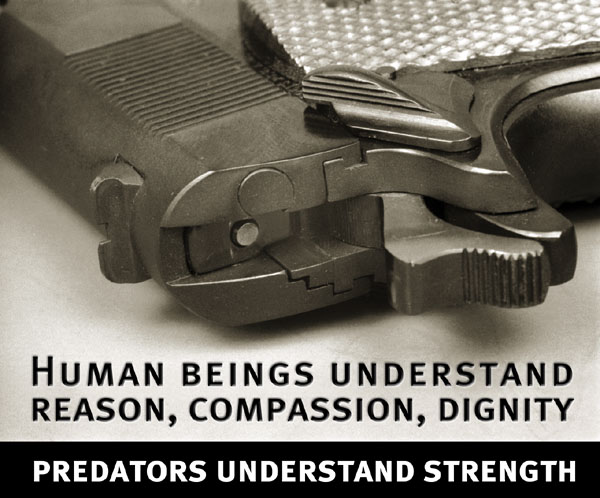
Like the poster says:

Side note: years ago I read an interview someone did with Ghandi, and he noted that his methods succeeded because he was dealing with a people as basically civilized as the British; people in India and back in Britain saw film and read the details of what was happening and had fits, and things changed. He specifically said that if he'd been dealing with the Soviets, not only would it not have worked, he and many of his followers would have disappeared into camps from which they would never have returned.
Like the poster says:
Friday, March 10, 2006
And we now know MA wants to be "Just like (formerly)Great Britain
How do we know this? Read and see. And be nauseated.
What's that? Why not stick the crooks in prison and keep them there for robbing and raping and murdering? What kind of barbarian ARE you, anyway?
What's that? Why not stick the crooks in prison and keep them there for robbing and raping and murdering? What kind of barbarian ARE you, anyway?
Ref the 1903 Springfield sights,
Take a look at this:

This is the rear in the laid-down position. At the right bottom, that large knob? Windage adjustment; it turns a pinion gear which meshes with teeth in the front of the sight and rotates it right or left; at the far left end you can see adjustment marks. Just right of the marks, see that hole? For 100 yards up to a couple of hundred, you were supposed to flip the ladder up and use the aperture for aiming. From that range(and there was an exact distance for these, but I'll look that up later, if I can find it again) on for a ways you used the notch in the base of the triangle above the aperture. For serious long range, that smaller knob is for elevation, loosen it and the whole notch/aperture setup slides up & down; please note that the elevation marks run all the way up to 2700 yards.
Now, if you look at the top of the aforementioned triangle, on the slider, you'll see a notch that's on top when the ladder is down, that's your battlesight. Remember I mentioned that most military rifles were set so that, with the sight in its' lowest position, it was actuall sighted for 300 yards/meters? Well, when this sight was designed for the original 1903 cartridge, it was. That one used a 220 grain roundnose bullet at about 2200 feet per second. Then the word came that the Germans had gone from a heavy roundnose bullet to a sharply-pointed bullet(spitzer) of much less weight, dropping from 220 to 150 grains. That allowed much higher velocity out of the Mauser, which meant a much flatter trajectory over distance, and- this bullet being more aerodynamic- longer effective range. So we did the same. The experiments led to the case being shortened .10", a 150 grain bullet was adopted at a velocity of about 2800 fps, giving us the ever-popular .30 Government 1906, later renamed the .30-06. However...
I can't remember the details(I do know where I can get a book that covers it, though) but the ballistics data for the new cartridge wasn't available in time for the sights to be made, so they were- mostly, at least- made with the markings from the 1903 cartridge. Which, with the higher velocity, more efficient projectile, meant that a battlesight originally designed for 300 yards actually was on at 500-something. Which means that at 100 yards, it's WAY high; where most are 3-6" high at 100, this hits about 8-10" high(rough numbers). And I have to point out that while that aperture for 'short' ranges works, that dinky little hole ain't worth crap in low light or bad weather(at least for me). Combine that with a thin front blade...
Gerry in comments brought up an old saying from WWI that the Americans had the best target rifle, the Germans had the best hunting rifle, and the Brits had the best battle rifle. Largely seems to cover it.
By the way, I've wondered for years, why did the Germans keep using that inverted 'V' front sight with the sharp point? THAT is also a bitch to use at times. The Swede Mausers use a similar, but it's got a flat top that's wide enough to use in low-light conditions, so why didn't the Germans use it?
For that matter, when the British were looking at a new rifle and designed the 1915(?) Enfield, I understand the different sights, but why did they go to a 5-shot magazine with it? The 10-shot of the #1 Mk3 worked so nicely, why change that?
Note: nice picture of 1903 sight found here, along with lots of other good pics of the rifle and parts.

This is the rear in the laid-down position. At the right bottom, that large knob? Windage adjustment; it turns a pinion gear which meshes with teeth in the front of the sight and rotates it right or left; at the far left end you can see adjustment marks. Just right of the marks, see that hole? For 100 yards up to a couple of hundred, you were supposed to flip the ladder up and use the aperture for aiming. From that range(and there was an exact distance for these, but I'll look that up later, if I can find it again) on for a ways you used the notch in the base of the triangle above the aperture. For serious long range, that smaller knob is for elevation, loosen it and the whole notch/aperture setup slides up & down; please note that the elevation marks run all the way up to 2700 yards.
Now, if you look at the top of the aforementioned triangle, on the slider, you'll see a notch that's on top when the ladder is down, that's your battlesight. Remember I mentioned that most military rifles were set so that, with the sight in its' lowest position, it was actuall sighted for 300 yards/meters? Well, when this sight was designed for the original 1903 cartridge, it was. That one used a 220 grain roundnose bullet at about 2200 feet per second. Then the word came that the Germans had gone from a heavy roundnose bullet to a sharply-pointed bullet(spitzer) of much less weight, dropping from 220 to 150 grains. That allowed much higher velocity out of the Mauser, which meant a much flatter trajectory over distance, and- this bullet being more aerodynamic- longer effective range. So we did the same. The experiments led to the case being shortened .10", a 150 grain bullet was adopted at a velocity of about 2800 fps, giving us the ever-popular .30 Government 1906, later renamed the .30-06. However...
I can't remember the details(I do know where I can get a book that covers it, though) but the ballistics data for the new cartridge wasn't available in time for the sights to be made, so they were- mostly, at least- made with the markings from the 1903 cartridge. Which, with the higher velocity, more efficient projectile, meant that a battlesight originally designed for 300 yards actually was on at 500-something. Which means that at 100 yards, it's WAY high; where most are 3-6" high at 100, this hits about 8-10" high(rough numbers). And I have to point out that while that aperture for 'short' ranges works, that dinky little hole ain't worth crap in low light or bad weather(at least for me). Combine that with a thin front blade...
Gerry in comments brought up an old saying from WWI that the Americans had the best target rifle, the Germans had the best hunting rifle, and the Brits had the best battle rifle. Largely seems to cover it.
By the way, I've wondered for years, why did the Germans keep using that inverted 'V' front sight with the sharp point? THAT is also a bitch to use at times. The Swede Mausers use a similar, but it's got a flat top that's wide enough to use in low-light conditions, so why didn't the Germans use it?
For that matter, when the British were looking at a new rifle and designed the 1915(?) Enfield, I understand the different sights, but why did they go to a 5-shot magazine with it? The 10-shot of the #1 Mk3 worked so nicely, why change that?
Note: nice picture of 1903 sight found here, along with lots of other good pics of the rifle and parts.
Thursday, March 09, 2006
Tuesday, March 07, 2006
Not having enough problems,
I shot a round in the current rifle postal match Mr. Completely & Friends has up. Not knowing when/if I'd have another chance on this one, I took the Martini 12 along the other day and shot this at 50 yards
First, let me say (whine)the wind was blowing strong, and it was gusting, and I didn't get much sleep the night before, dammit!(/whine). That being said, biggest problem was the size of the targets and my vision. At 50 yards, these suckers are little blurs, and I'm frankly amazed I did as well as I did. Usually, for an iron sight target at that range I use a black bullseye about 2.5" across; lots better contrast than this multi-colored !!&*%!.
In any case, there's mine. Where's yours?
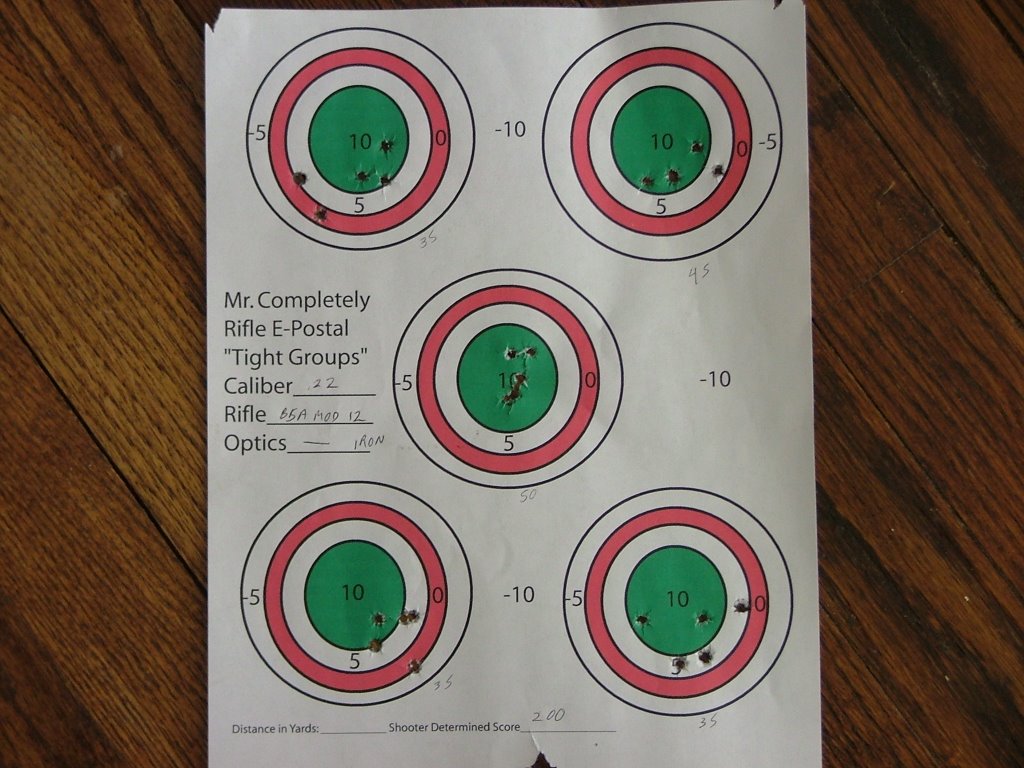
First, let me say (whine)the wind was blowing strong, and it was gusting, and I didn't get much sleep the night before, dammit!(/whine). That being said, biggest problem was the size of the targets and my vision. At 50 yards, these suckers are little blurs, and I'm frankly amazed I did as well as I did. Usually, for an iron sight target at that range I use a black bullseye about 2.5" across; lots better contrast than this multi-colored !!&*%!.
In any case, there's mine. Where's yours?
Monday, March 06, 2006
Range day
Having once again decided to hell with various things I probably should have done, I went shooting today. Nice day for this time of year, though a bit windy and gusty. No serious testing or whatever, though I did get to try out a Finnish M39
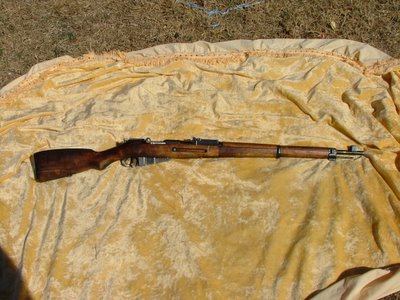
Short version, this is the rifle the Finns made using Mosin-Nagant receivers. I've heard that they're the best version made of this rifle type, and having shot this one I believe it. For the full rundown on these go over to Head's Bunker and look down the sidebar; he's got a lot on them. Short version:
heavier stock, particularly in the forend. Instead of a long, skinny one it's a heavier piece dovetailed into the buttstock.
Better sights. Instead of a shallow notch in the rear and a post up front, it's a wing-protected front blade and a very clean rear notch. And where every other rifle of the type, although the low setting says '100' is actually set for 300 meters? This Finn rifle has a low setting marked '150', and it means it; with the ammo I used(Czech and Polish light ball) it hit just about dead-on at 100, I'd guess would be on at 150.
Windage adjustment on other Mosins means drifting the front sight in the dovetail, and if you've ever done that you know it's a bit touchy at times to get it just right. With this? There's a screw on each side of the sight base; to move the sight left, you'd back the left screw off a bit, then tighten the right screw. Presto, very controlled, positive adjustment. I like it.
And it's got the best trigger I've personally seen on a Mosin, long first stage, positive stop, then a light, clean second stage. Very nice. I've fired much newer sporting rifles with worse.
First five shots were done at 50 yards
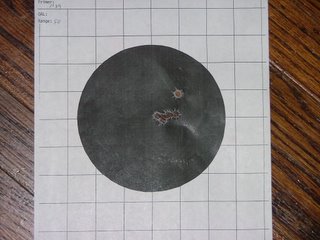
Which impressed me. Then moved back to 100
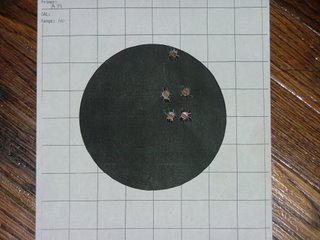
The flier I blame on myself, which gives a 1" group. Which was not a fluke, I got several more this tight with it, though the rifle showed a bit of a preference for the Polish ammo.
If I were going to set one of these up for target shooting, I think the main thing I'd do is get another front blade and mill it a bit thinner. These are battle-rifle sights, not match sights, and for the purpose I imagine they served- would serve- very well.
As an aside, I read that when the M1 Garand was first officially introduced to the public at the Wimbledon matches, the two big gripes were the coarse sights and 'too heavy' trigger. The Springfield people kept telling them "It's not a match rifle, it's a battlefield rifle, too fine a sight and too light a trigger can be a problem". This is my big gripe with the 1903 and 1903-A3 Springfields; fine rifles with lousy sights for woods or battlefield use. With the -A3, a fine rear aperture sight combined with that damn thin front blade; with the '03, skinny front blade and a too-complicated rear. Excellent on a target range, a pain anywhere else. In my humble opinion, anyway.
In any case, back to the M39, this is a fine rifle, and happily there are a bunch of them out there. I get my finances back on track, I may have to search around for one.
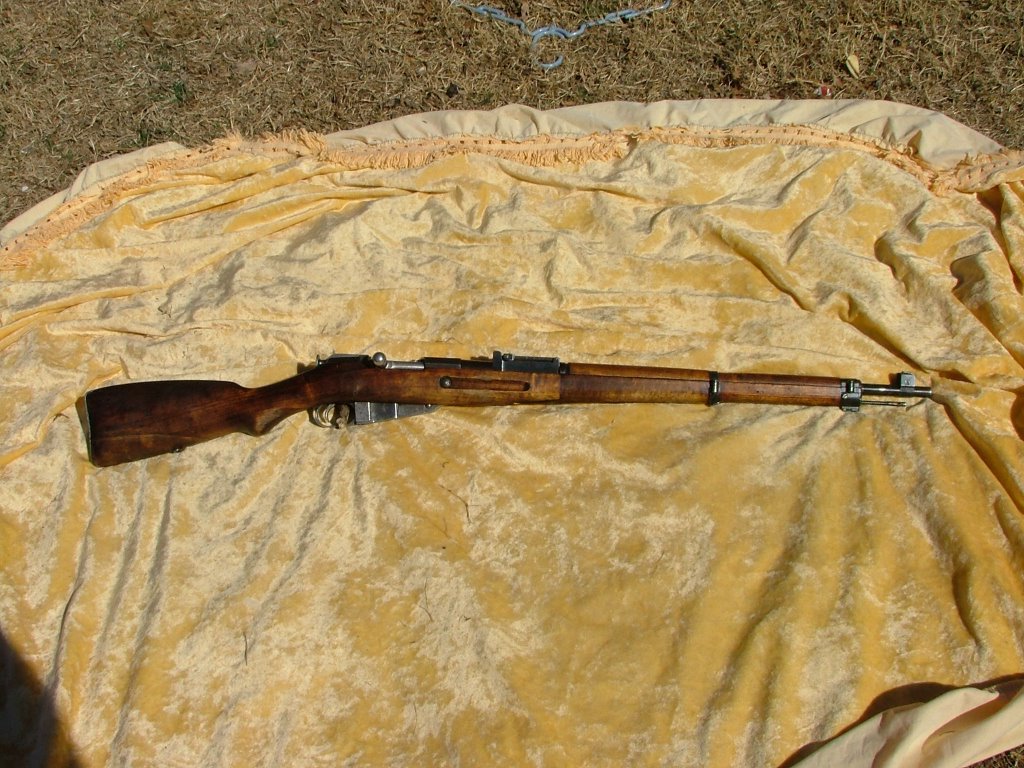
Short version, this is the rifle the Finns made using Mosin-Nagant receivers. I've heard that they're the best version made of this rifle type, and having shot this one I believe it. For the full rundown on these go over to Head's Bunker and look down the sidebar; he's got a lot on them. Short version:
heavier stock, particularly in the forend. Instead of a long, skinny one it's a heavier piece dovetailed into the buttstock.
Better sights. Instead of a shallow notch in the rear and a post up front, it's a wing-protected front blade and a very clean rear notch. And where every other rifle of the type, although the low setting says '100' is actually set for 300 meters? This Finn rifle has a low setting marked '150', and it means it; with the ammo I used(Czech and Polish light ball) it hit just about dead-on at 100, I'd guess would be on at 150.
Windage adjustment on other Mosins means drifting the front sight in the dovetail, and if you've ever done that you know it's a bit touchy at times to get it just right. With this? There's a screw on each side of the sight base; to move the sight left, you'd back the left screw off a bit, then tighten the right screw. Presto, very controlled, positive adjustment. I like it.
And it's got the best trigger I've personally seen on a Mosin, long first stage, positive stop, then a light, clean second stage. Very nice. I've fired much newer sporting rifles with worse.
First five shots were done at 50 yards

Which impressed me. Then moved back to 100

The flier I blame on myself, which gives a 1" group. Which was not a fluke, I got several more this tight with it, though the rifle showed a bit of a preference for the Polish ammo.
If I were going to set one of these up for target shooting, I think the main thing I'd do is get another front blade and mill it a bit thinner. These are battle-rifle sights, not match sights, and for the purpose I imagine they served- would serve- very well.
As an aside, I read that when the M1 Garand was first officially introduced to the public at the Wimbledon matches, the two big gripes were the coarse sights and 'too heavy' trigger. The Springfield people kept telling them "It's not a match rifle, it's a battlefield rifle, too fine a sight and too light a trigger can be a problem". This is my big gripe with the 1903 and 1903-A3 Springfields; fine rifles with lousy sights for woods or battlefield use. With the -A3, a fine rear aperture sight combined with that damn thin front blade; with the '03, skinny front blade and a too-complicated rear. Excellent on a target range, a pain anywhere else. In my humble opinion, anyway.
In any case, back to the M39, this is a fine rifle, and happily there are a bunch of them out there. I get my finances back on track, I may have to search around for one.
Refugee asked, so
Here's a closer shot of the blooms

And I must correct myself; the blooms open from the bottom up

And I must correct myself; the blooms open from the bottom up
Sunday, March 05, 2006
Ever seen an aloe vera bloom?
I hadn't, until my parents gave me this one. About nine years ago, I believe; as much hot metal as I handled at the time, it came in very handy for burns. I moved it indoors when winter came, and sometime in February I noticed a stalk rising from the center. It grew to about a foot or so higher than the rest of the plant, the head opened up into lots of little buds, and they finally started opening from top to bottom, each a small bloom.


No scent that I could catch. After opening, they withered and fell off, again from top to botttom. First time that I'd ever seen it.
And so far, the first time of anyone I've told about it. Every year, about the same time, it sends up a stalk. The first couple of years just a single head, since then it's branched off and produced two.
Just think it's interesting.


No scent that I could catch. After opening, they withered and fell off, again from top to botttom. First time that I'd ever seen it.
And so far, the first time of anyone I've told about it. Every year, about the same time, it sends up a stalk. The first couple of years just a single head, since then it's branched off and produced two.
Just think it's interesting.
Friday, March 03, 2006
A good place to check out
is Samizdata. I hadn't been over there in quite a while, then today remembered to go by. You should check it out, if for no other reason than that it'll scare hell out of you by noting things happening in once-Great Britain. If you've ever though we should copy where they're going, this should cure you of it.
Carnival of Cordite #50!
The fiftieth one of these things, up at guest host AnarchAngel. Including a really good video for those who've thought "I could end that movie right now!"
Hello? Illinois, Chicago? You paying attention?
Probably not; one of these items the clowns will probably see as a bonus, and the other they'll ignore.
'These items' being the following: while over at the High Road I found a thread "More job losses for Illinois, YYYEEEAAAHHH!!" It seems that a number of gunmakers have said flatly that if Illinois passes the current 'Ban the Eeeville Guns' law, they'll leave the state. Taking their jobs and revenue with them. Guys, may I suggest Oklahoma? I think I'd like to work for Springfield Armory or ArmaLite. Full story here.
Second item was an article also on the Illinois State Rifle Assn. site, "Brady Gun Control Campaign All Wet Say Nation's Top Cops". Good reading in general.
So the National Association of Chiefs of Police says the Bradys and their buttmonkeys are full of crap, and if the IL legislature doesn't have a moment of intelligence(in Daley-Land, how likely is that?) I might have a place moving here that I'd take early retirement to get a job at.
Speaking of liberal asshats('redundancy alert' as Kim says), mAss Backwards notes this: "Security Grates Cause Crime". I have to ask, how does that idiot Mumbles get into and stay in office? Jeez.
'These items' being the following: while over at the High Road I found a thread "More job losses for Illinois, YYYEEEAAAHHH!!" It seems that a number of gunmakers have said flatly that if Illinois passes the current 'Ban the Eeeville Guns' law, they'll leave the state. Taking their jobs and revenue with them. Guys, may I suggest Oklahoma? I think I'd like to work for Springfield Armory or ArmaLite. Full story here.
Second item was an article also on the Illinois State Rifle Assn. site, "Brady Gun Control Campaign All Wet Say Nation's Top Cops". Good reading in general.
So the National Association of Chiefs of Police says the Bradys and their buttmonkeys are full of crap, and if the IL legislature doesn't have a moment of intelligence(in Daley-Land, how likely is that?) I might have a place moving here that I'd take early retirement to get a job at.
Speaking of liberal asshats('redundancy alert' as Kim says), mAss Backwards notes this: "Security Grates Cause Crime". I have to ask, how does that idiot Mumbles get into and stay in office? Jeez.
Thursday, March 02, 2006
And if you're as sick of the UN as I am,
Mark Steyn lays out everything you need to tell people who still trust it here.
Remember the kid who blew up in Norman?
Outside the packed stadium? Who the university and various people assured us was 'just a troubled kid who killed himself'?
"A Norman police bomb expert said Tuesday he does not believe University of Oklahoma student Joel Henry Hinrichs III committed suicide by blowing himself up outside a packed football stadium. "I believe he accidentally blew himself up," Sgt. George Mauldin said."
Link to the article here at Powerline, Michelle Malkin's post here. Among other things found at his apartment "A pint-size Tupperware container on a counter was filled with TATP Hinrichs had manufactured, Mauldin said." That's on top of what blew him up. Which was "Mauldin said Hinrichs, 21, an engineering student, had two to three pounds of triacetone triperoxide, commonly known as TATP, in a backpack in his lap when it exploded Oct. 1." Two to three pounds?!?
'Troubled youth suicide' my ass.
"A Norman police bomb expert said Tuesday he does not believe University of Oklahoma student Joel Henry Hinrichs III committed suicide by blowing himself up outside a packed football stadium. "I believe he accidentally blew himself up," Sgt. George Mauldin said."
Link to the article here at Powerline, Michelle Malkin's post here. Among other things found at his apartment "A pint-size Tupperware container on a counter was filled with TATP Hinrichs had manufactured, Mauldin said." That's on top of what blew him up. Which was "Mauldin said Hinrichs, 21, an engineering student, had two to three pounds of triacetone triperoxide, commonly known as TATP, in a backpack in his lap when it exploded Oct. 1." Two to three pounds?!?
'Troubled youth suicide' my ass.
Wednesday, March 01, 2006
Once again, I shall preach
on tolerance. And the lack thereof on some subjects. In this case, smoking.
As of today, all restaurants in this state have to either have a separate smoking area, with separate air-handling, or be smoke-free. And it's being pushed to, within a few years, make all smoking in public places illegal. All day the news has had interviews with the Cancer Society rep and various Health Department personnel and politicians speaking of the evils of smoking and secondhand smoke and so on.
I can only say to these people, WILL YOU FUCK OFF?!?
Once again, the nanny-state politicians and busybodies have managed to further criminalize something mostly on the basis of "We disapprove, and it's for your own good, you know!". I repeat, FUCK OFF! If I go into a restaurant or club and it's smoky and I don't like it, I leave and go somewhere else. I don't go whining to some politician to pass a law, and don't scream about violations of my 'rights', I just spend my money elsewhere.
One of the commercials these assholes had running over the past few months spoke of the 'hundreds' of people killed in this state every year by secondhand smoke. BULLSHIT. Unless some actual honest study has been pulled out of the hat lately, there's still no actual proof that ANYONE has been killed by it. Yeah, it's annoying. So what? So are busybody idiots and vote-hungry suckup politicians. That doesn't make it lethal, and lying about it doesn't make it so. The clowns who want to ban anything they disapprove of and claim is 'unhealthy' are a bigger threat to me; they're actually punishing people and attacking personal freedoms and actions, which DOES threaten me where secondhand smoke doesn't.
Makes me want to get a pipe and light up where the clowns can see me, just to annoy them. Maybe I'd be lucky and their indignation would rise so high it'd choke them.
I'm too pissed by all this to continue. Amen, and follow me to the bar.
Cigars, pipes and all.
As of today, all restaurants in this state have to either have a separate smoking area, with separate air-handling, or be smoke-free. And it's being pushed to, within a few years, make all smoking in public places illegal. All day the news has had interviews with the Cancer Society rep and various Health Department personnel and politicians speaking of the evils of smoking and secondhand smoke and so on.
I can only say to these people, WILL YOU FUCK OFF?!?
Once again, the nanny-state politicians and busybodies have managed to further criminalize something mostly on the basis of "We disapprove, and it's for your own good, you know!". I repeat, FUCK OFF! If I go into a restaurant or club and it's smoky and I don't like it, I leave and go somewhere else. I don't go whining to some politician to pass a law, and don't scream about violations of my 'rights', I just spend my money elsewhere.
One of the commercials these assholes had running over the past few months spoke of the 'hundreds' of people killed in this state every year by secondhand smoke. BULLSHIT. Unless some actual honest study has been pulled out of the hat lately, there's still no actual proof that ANYONE has been killed by it. Yeah, it's annoying. So what? So are busybody idiots and vote-hungry suckup politicians. That doesn't make it lethal, and lying about it doesn't make it so. The clowns who want to ban anything they disapprove of and claim is 'unhealthy' are a bigger threat to me; they're actually punishing people and attacking personal freedoms and actions, which DOES threaten me where secondhand smoke doesn't.
Makes me want to get a pipe and light up where the clowns can see me, just to annoy them. Maybe I'd be lucky and their indignation would rise so high it'd choke them.
I'm too pissed by all this to continue. Amen, and follow me to the bar.
Cigars, pipes and all.
Further thoughts from range evening
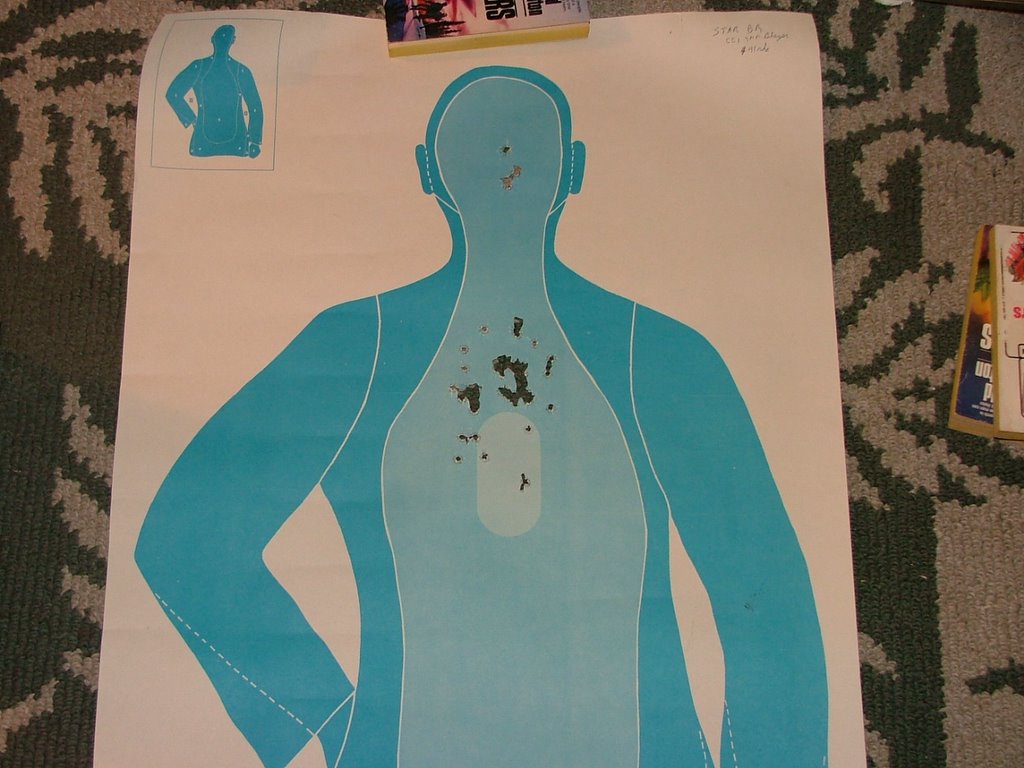
Two things I've picked up from reading over the last year or so are a: to change my primary aiming point and b: get more practice both close & fast and moving. Instead of center of mass, upper center of mass; last night that meant moving the smurf from about 5 yards back up to 3, about half the shots at each. 'Moving' in this case meant shifting side-to-side and back-&-forth within about a 3x5' space. Indoor range, other folks around, so keeping the jumping and etc. for later. Results:

Fifty rounds, including mag changes. It's not the best way, but somewhat careful mag changes; I didn't want to drop the damn things on the concrete floor, so they were a bit slow. All in all, not too bad. Aiming and firing while shifting around, even over a small space, really makes a difference from a steady, fixed firing position.
This kind of thing is where having a .22 conversion for a pistol is nice, you can go through a lot of ammo getting the hang of it without going broke or spending a lot of time at the loading bench. If you're at a range where they're understanding about such things, or- as I prefer- the outdoor one I usually go to for rifle practice(often nobody else at the handgun section), you can really move; jumping or stepping quickly back a ways, moving a few steps side-to-side, and moving at a quick pace along the line and engaging two targets as you pass along. It pumps your heart up a bit, it prevents you from standing still, and it gives some feel for shooting on the move. I can't remember if it was Kevin or the Geek who originally pointed out that you need to move; it was that very nice post of the Geek's on aiming point that started me aiming a bit higher. One thing that brought out is how strong habit is; even after working on this over time, I still sometimes will catch myself firing my first shot or two COM. They hit where I'm aiming, but it's not the aiming point I'm training myself to.
Oh, the head shots? Last few rounds. Well, hell, I had to try it, didn't I?
Something else I wanted to write about, which will undoubtedly annoy some people. Currently 'Keep your finger off the trigger 'till your sights are on the target' has come to mean 'keep your finger straight along the frame'. While it does indeed keep your finger away from the trigger, I have to point out that it's not required to keep it straight. I was taught handgun by my father, and he was taught combat shooting by the LE agency he worked for. You could have your finger inside the trigger guard, as long as it did not touch the trigger. This was in the days of almost everybody carrying a revolver, and if your finger did brush the trigger, it wasn't a big deal; it still took an actual pull to cycle the action and fire. I read somewhere that having the finger straight came from the fact that a rangemaster could see that and know you weren't on the trigger without having to look closely; makes sense. I've noticed that when I'm using a revolver I still do it that way; finger inside the guard, but at the front so I'm not touching the trigger. With a semi-auto, I keep it outside the guard. With a single-action auto pistol, my though when I started handling them was that, if the safety was off it wouldn't take much to fire a shot accidentally if you had that finger inside, so keep it out. Yeah, you shouldn't take the safety off until lining up to fire, and I don't; it's the principle of the thing. So, without thinking about it, I use the two positions depending on which type of pistol I'm firing. Works quite well so far.
Anyway, there's my two cents worth about it.
Fifty rounds, including mag changes. It's not the best way, but somewhat careful mag changes; I didn't want to drop the damn things on the concrete floor, so they were a bit slow. All in all, not too bad. Aiming and firing while shifting around, even over a small space, really makes a difference from a steady, fixed firing position.
This kind of thing is where having a .22 conversion for a pistol is nice, you can go through a lot of ammo getting the hang of it without going broke or spending a lot of time at the loading bench. If you're at a range where they're understanding about such things, or- as I prefer- the outdoor one I usually go to for rifle practice(often nobody else at the handgun section), you can really move; jumping or stepping quickly back a ways, moving a few steps side-to-side, and moving at a quick pace along the line and engaging two targets as you pass along. It pumps your heart up a bit, it prevents you from standing still, and it gives some feel for shooting on the move. I can't remember if it was Kevin or the Geek who originally pointed out that you need to move; it was that very nice post of the Geek's on aiming point that started me aiming a bit higher. One thing that brought out is how strong habit is; even after working on this over time, I still sometimes will catch myself firing my first shot or two COM. They hit where I'm aiming, but it's not the aiming point I'm training myself to.
Oh, the head shots? Last few rounds. Well, hell, I had to try it, didn't I?
Something else I wanted to write about, which will undoubtedly annoy some people. Currently 'Keep your finger off the trigger 'till your sights are on the target' has come to mean 'keep your finger straight along the frame'. While it does indeed keep your finger away from the trigger, I have to point out that it's not required to keep it straight. I was taught handgun by my father, and he was taught combat shooting by the LE agency he worked for. You could have your finger inside the trigger guard, as long as it did not touch the trigger. This was in the days of almost everybody carrying a revolver, and if your finger did brush the trigger, it wasn't a big deal; it still took an actual pull to cycle the action and fire. I read somewhere that having the finger straight came from the fact that a rangemaster could see that and know you weren't on the trigger without having to look closely; makes sense. I've noticed that when I'm using a revolver I still do it that way; finger inside the guard, but at the front so I'm not touching the trigger. With a semi-auto, I keep it outside the guard. With a single-action auto pistol, my though when I started handling them was that, if the safety was off it wouldn't take much to fire a shot accidentally if you had that finger inside, so keep it out. Yeah, you shouldn't take the safety off until lining up to fire, and I don't; it's the principle of the thing. So, without thinking about it, I use the two positions depending on which type of pistol I'm firing. Works quite well so far.
Anyway, there's my two cents worth about it.
This ain't no Polish joke
In it's way, this is Poland declaring war. Or at least what side they're on.
Poland fought the German National Socialists long and hard. Then they fought, in a much more low-key way, against the Soviet tyranny. Now they're looking the Islamic fascists in the eye and spitting.
I can only say, Well Done!
Poland fought the German National Socialists long and hard. Then they fought, in a much more low-key way, against the Soviet tyranny. Now they're looking the Islamic fascists in the eye and spitting.
I can only say, Well Done!
Range night
Went to the range last night, having a desire to blow off some steam and make loud noises. Mostly stuff I've shot before(with one exception I'll write of later), and general practice.
Shot the Enfield .380/200 revolver I wrote of before, using that handload put together for it. Every time I've fired one of these before it's been with the Remington loads(which are fairly light) or handloads meant to duplicate it. And it's not an impressive load. This uses a 190-grain bullet loaded to duplicate the original British military load for it, and it's a different matter. For one thing it actually shoots to point of aim, where the light stuff hits way low; for another it's much more authoritative. It's not a .38 Special Hydra-Shok, but I don't think it's that far behind. 190 grains of somewhat soft bullet at 650-700 fps is NOT something a bad guy would shrug off. I understand why the commercial loads are so light; there are a lot of old revolvers out there not in very good condition, and they don't want to overstress them. Thing is, there are also a lot out there that are in fine condition and have no problem with their original load, and it's too bad you have to handload to get what they were designed to put out.
It's also a lot more accurate than people tend to think. That double-action(when clean and lubed; a lot of them you might get hold of are bone-dry inside) is very smooth, and that helps to put the shots where the you want. With these loads, this would make a good home-defense gun. Solid, accurate and dependable; what more could you want?
Shot the Enfield .380/200 revolver I wrote of before, using that handload put together for it. Every time I've fired one of these before it's been with the Remington loads(which are fairly light) or handloads meant to duplicate it. And it's not an impressive load. This uses a 190-grain bullet loaded to duplicate the original British military load for it, and it's a different matter. For one thing it actually shoots to point of aim, where the light stuff hits way low; for another it's much more authoritative. It's not a .38 Special Hydra-Shok, but I don't think it's that far behind. 190 grains of somewhat soft bullet at 650-700 fps is NOT something a bad guy would shrug off. I understand why the commercial loads are so light; there are a lot of old revolvers out there not in very good condition, and they don't want to overstress them. Thing is, there are also a lot out there that are in fine condition and have no problem with their original load, and it's too bad you have to handload to get what they were designed to put out.
It's also a lot more accurate than people tend to think. That double-action(when clean and lubed; a lot of them you might get hold of are bone-dry inside) is very smooth, and that helps to put the shots where the you want. With these loads, this would make a good home-defense gun. Solid, accurate and dependable; what more could you want?
Sunday, February 26, 2006
Followup on cleaning: sanding
Whether you're just touching up an old stock or completely refinishing, you'll find that, even after a good degreasing, the sandpaper will clog up fast. For just touching up, no big deal, you're not doing that much. For complete refinishing, it is a big deal, you'll go through a lot of it. So if you're taking all the old finish and surface off, I will suggest using a scraper.
A scraper will cut fast and clean, and won't clog; at most you'll just have to wipe off the edge every so often. You can buy commercially-made scrapers at woodworking shops and suppliers, or you can make your own. Two ways to make them.
DISCLAIMER: the first method yields a good scraper that will, if you're not careful, slice you worse than what you're working on. Use gloves and be damn careful, and if you start hemmoraging don't blame me.
The simplest, cheapest way is to use glass. Get something like a mayonnaise jar, wrap it in something and break it, or break a piece of almost any piece of glass. The edges will be VERY sharp, and if you're not careful will slice you as you work, so use gloves and BE CAREFUL.
The other way is to make it of metal. What was recommended to me some years ago was an old hand-saw blade. Use a Dremel and cutoff wheel, or a grinder with said wheel, or just use the corner of a grinding wheel to cut a groove along which you can break a piece off. Then grind the edges you cut square, and as smooth as possible. Here a sanding drum or belt sander works very well. You also want to touch up wth sides, to the edge is square a smooth. Now comes the tricky part. For a very fine cut you can use it as is, but to take off material fairly quickly you need to forma 'hook' along the edge. The way I was shown was to clamp the piece in a vise, take a screwdriver with a round shank- the smooth part of a round file, basically anything rounded, smooth and hard enough will work- and push and pull it along the edge, tilted toward the edge you're forming the hook on. It forces the corner to curl over a bit, giving you a very aggressive cutting edge. You can do all sides if you wish, I'd suggest only hooking the edge or edges you plan on using, so you don't have to worry about cutting yourself on a fresh edge.
Generally, with glass or steel, you want a piece with a curve to the edge, which will let you work around the curves in the stock better. Hold the scraper(Carefully, I said!) with the working edge trailing your hand; you're not pushing it into the wood, you're dragging it across the surface. A little trial and error will show you the best angle, that varies according to the wood and the tool. Drag it a ways, see how deep and wide it cut, make the next pass and observe; you'll find the best angle to work the piece at. You'll also produce lots of fine shavings, and in the case of an old gunstock you'll be removing the crud at the surface along with the wood. You can work the entire piece, or just in an area that needs serious cutdown.
When you're done, you'll have a stock with a much cleaner, smoother surface, ready for sanding. And you'll have much less trouble with the sandpaper clogging.
Note: I'm going to splice this into the 'Cleaning' post, so as to keep it all together.
A scraper will cut fast and clean, and won't clog; at most you'll just have to wipe off the edge every so often. You can buy commercially-made scrapers at woodworking shops and suppliers, or you can make your own. Two ways to make them.
DISCLAIMER: the first method yields a good scraper that will, if you're not careful, slice you worse than what you're working on. Use gloves and be damn careful, and if you start hemmoraging don't blame me.
The simplest, cheapest way is to use glass. Get something like a mayonnaise jar, wrap it in something and break it, or break a piece of almost any piece of glass. The edges will be VERY sharp, and if you're not careful will slice you as you work, so use gloves and BE CAREFUL.
The other way is to make it of metal. What was recommended to me some years ago was an old hand-saw blade. Use a Dremel and cutoff wheel, or a grinder with said wheel, or just use the corner of a grinding wheel to cut a groove along which you can break a piece off. Then grind the edges you cut square, and as smooth as possible. Here a sanding drum or belt sander works very well. You also want to touch up wth sides, to the edge is square a smooth. Now comes the tricky part. For a very fine cut you can use it as is, but to take off material fairly quickly you need to forma 'hook' along the edge. The way I was shown was to clamp the piece in a vise, take a screwdriver with a round shank- the smooth part of a round file, basically anything rounded, smooth and hard enough will work- and push and pull it along the edge, tilted toward the edge you're forming the hook on. It forces the corner to curl over a bit, giving you a very aggressive cutting edge. You can do all sides if you wish, I'd suggest only hooking the edge or edges you plan on using, so you don't have to worry about cutting yourself on a fresh edge.
Generally, with glass or steel, you want a piece with a curve to the edge, which will let you work around the curves in the stock better. Hold the scraper(Carefully, I said!) with the working edge trailing your hand; you're not pushing it into the wood, you're dragging it across the surface. A little trial and error will show you the best angle, that varies according to the wood and the tool. Drag it a ways, see how deep and wide it cut, make the next pass and observe; you'll find the best angle to work the piece at. You'll also produce lots of fine shavings, and in the case of an old gunstock you'll be removing the crud at the surface along with the wood. You can work the entire piece, or just in an area that needs serious cutdown.
When you're done, you'll have a stock with a much cleaner, smoother surface, ready for sanding. And you'll have much less trouble with the sandpaper clogging.
Note: I'm going to splice this into the 'Cleaning' post, so as to keep it all together.
Subscribe to:
Posts (Atom)